Boston College Athletics
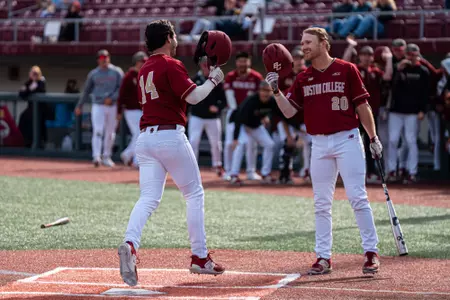
Photo by: Joe Sullivan
How Brighton Transformed BC Baseball
May 28, 2023 | Baseball, #ForBoston Files
This team, this program, this city deserves a chance to host a Boston Regional.
Boston College's run to the Super Regional round of the 2016 NCAA Tournament offered one of the Eagles' more memorable, golden moments on a baseball diamond. It was seven years after BC's 25-inning marathon against Texas in the second round of a regional hosted by the Longhorns, and having endured a rebuilding process centered around a class that initially lost 40 games in during the 2012 season, Birdball stood one game away from reaching Omaha's College World Series after pushing ACC compatriot Miami to a winner-take-all third game.
Watershed wins existed at virtually every turn, and each game lifted the program's culture to unprecedented heights in baseball's modern era. The nation learned about Birdball and its unique relationship with Pete Frates and the fight against ALS, and the hard-nosed, Northeast baseball style defined by pitching and an old school, blue collar mentality tied everything together during the ACC Tournament-clinching win over Georgia Tech and the undefeated regional run in Oxford, Mississippi.
BC stood on the precipice of a major national breakthrough, and the nation celebrated the Eagles for their accomplishments without ever noticing how close the program came to a major embarrassment. The Super Regional was at Miami, but one week earlier, Long Beach State forced the Hurricanes to rally in the front end of the Regional Final. The Dirtbags already had an 11-inning loss to Miami, and had they managed to force an elimination game, a situation existed where BC could have been in position to host the Super Regionals, a position its program never could have supported.
"In 2016, we won our regional at Mississippi with Miami on the other side [of the bracket]," said head coach Mike Gambino, "and at some point on Sunday afternoon, we were kind of joking that if Miami hadn't won its regional, we couldn't have come back home for a Super."
Understanding how BC existed in those days is a reason why Sunday offers a special, emotional conversation for the entire program. The team that once played on a parking lot with temporary fencing surrounding a field that seemingly retained as much water as the Chestnut Hill Reservoir is one announcement away from hosting a nationally-seeded regional. Players who existed in the bitter winds blowing off of Alumni Stadium's concrete pillars have a home to call their own, and if projections are correct, next weekend will offer a centerpiece experience unlike anything ever experienced in the 77-year history of Boston College baseball.
"This will be a huge deal for our program and a huge deal for our university," Gambino, himself a BC baseball alum, explained. "The one thing you can say about our program is that we talk about all of this being 'our thing.' It's not just the boys on the field. It's the staff, the donors, the former players, the alumni that rallied all these past years. That group of faithful donors, former players, alumni - they all fought and fought and fought to get us to this spot."
Understanding how BC wound up in this situation - and its previous situations - requires a bit of contextualization around the setup of the NCAA Tournament. The tournament itself breaks a 64-team bracket into 16 regionals. Each regional hosts four teams for a double-elimination format, to which surviving teams advance to a Super Regional round that's a best-of-three series. Eight teams advance to the College World Series, which is itself a double-elimination bracket at a fixed location at Charles Schwab Field in Omaha, Nebraska, and the two remaining teams play a best-of-three series to determine the national champion.
Regionals and Super Regionals each utilize hosting sites, and priority is given in each round to the team with the better seed. That means 16 teams are chosen as regional hosts, and the top eight national seeds are guaranteed to host both Regionals and Super Regionals if they advance. Teams seeded nine through 16 host a regional but travel for the Super Regionals unless the top seed in the top-8 bracket falls, and if no No. 1 seed exists, teams are allowed to bid for the next round of the tournament with prioritization given to the better seeds.
Five of the 16 regional hosts lost on home turf during that 2016 tournament, and three No. 1 seeds never even advanced to the Regional Final. One of those - Clemson - was a top-8 seed, but BC was slotted as a No. 3 seed opposite top-seeded Ole Miss and No. 2 Tulane in a regional that fed into the No. 3 national seed's Super Regional path.
Miami was guaranteed to host in that situation, but the Hurricanes needed 11 innings to beat third-seeded Long Beach State in the second round of the regional bracket, which dropped the Dirtbags into an elimination round game against Florida Atlantic, the No. 2 seed in the bracket. They summarily won, which meant a win over Miami in the Regional Final would set up a winner-take-all elimination game to advance to the Super Regionals.
Had Long Beach State won, BC would have had an opportunity to host the Super Regionals by bidding against the Dirtbags, a four-time College World Series qualifier, but it was well-known that there was no way the Eagles could have hosted a best-of-three series at Shea Field, a field barely suited for regular season games. It didn't have locker rooms, let alone hitting tunnels, and the lack of space made it impossible to expand the seating areas that didn't totally exist.
The field itself was a tailgating lot during football season, and the outfield fence was temporary plywood that was added and removed for the spring season. Most fans stood on the Beacon St. parking garage's Alumni Stadium ramp, and while it created a unique atmosphere, it was not a stadium worth showcasing.
"Nobody forgets, but five years ago, we didn't have a baseball field," Gambino said. "The first thing anybody said about our program was that we were playing in a parking lot. They talked about tailgating on the baseball field, and that's when [our current seniors] were juniors and seniors in high school."
The situation had to change, but lost in the shuffle of that 2016 season was the February announcement that the university would invest $200 million in facilities upgrades and improvements. Shea Field became the site for the football program's Fish Field House, and baseball and softball shifted across Comm. Ave. to the university's Brighton campus, formerly the site of St. John's Seminary.
A field at the bottom of the campus transformed into the Harrington Athletics Village, and two years later, baseball and softball moved onto state-of-the art artificial turf fields. The Pete Frates Center followed with locker rooms and indoor practice facilities for both programs, and after opening during the COVID-19 pandemic, the entire complex won acclaim for its ability to provide a diamond sports-centric atmosphere unique to the Brighton campus.
That whole backstory is an intricate part of why BC deserves to host a regional. Thirteen years ago, UConn hosted a regional at Dodd Memorial Stadium in Norwich, Conn., but the Huskies were the No. 2 seed and failed to advance out of the elimination bracket's second round after losing to third-seeded Oregon in the first round. They were in a regional with top-seeded Florida State, which hosted the Super Regional round, and the lone highlight of the region was a 25-5 win over Central Connecticut after the Blue Devils surrendered 11 runs in their first round loss to the Seminoles.
That bracket was off-campus, and there hasn't been an on-campus regional in the Northeast since Clemson was the top-seed in a five-team bracket hosted by Maine during the 1991 NCAA Tournament. But even that tournament only had 48 teams and predated the current 64-team, Super Regional setup stamping college baseball's modern era.
The Northeast has simply been an afterthought, at least until now, but with an explosion of teams from the region ready to compete, BC is the team now standing at the forefront. A 30-year gap could end on Sunday, and if the NCAA chooses - finally - to showcase New England college baseball, the Eagles would breach one last glass ceiling that separated them from the rest of the Division I ranks.
It's a fact that cannot be understated and can only be understood by the people who cheered BC's Beanpot victory over Harvard or its win over Duke on the anniversary of the Boston Marathon. Nobody who rose as one group to cheer a final pitch win over opponents from Clemson to Villanova can fathom that feeling without first freezing at Shea Field while trudging to the outdoor press box exposed to the elements. People who parked on the grass to tailgate for football wouldn't understand what it's like to see this moment unless they returned to watch a game inside the temporary fence.
What instead makes it possible to quantify is the full understanding of what BC built this stadium to represent. Followers of the eagles know it, and now a whole city is behind the driving force. This is the program's moment, the university's moment, and it won't be at some off-site location, won't be in Brockton, and won't be at some other school's facility. It'll be in Boston, with BC's home base, on campus, and will undeniably showcase a program waiting to burst onto the national scene in a way that's been experienced before.
"Adding the baseball field and the Pete Frates Center, we have a facility that we can be proud of," Gambino said. "We have the ability to show that off in the postseason…the thing about it is that the city of Boston turns out for big events, and this will be a big deal."
Watershed wins existed at virtually every turn, and each game lifted the program's culture to unprecedented heights in baseball's modern era. The nation learned about Birdball and its unique relationship with Pete Frates and the fight against ALS, and the hard-nosed, Northeast baseball style defined by pitching and an old school, blue collar mentality tied everything together during the ACC Tournament-clinching win over Georgia Tech and the undefeated regional run in Oxford, Mississippi.
BC stood on the precipice of a major national breakthrough, and the nation celebrated the Eagles for their accomplishments without ever noticing how close the program came to a major embarrassment. The Super Regional was at Miami, but one week earlier, Long Beach State forced the Hurricanes to rally in the front end of the Regional Final. The Dirtbags already had an 11-inning loss to Miami, and had they managed to force an elimination game, a situation existed where BC could have been in position to host the Super Regionals, a position its program never could have supported.
"In 2016, we won our regional at Mississippi with Miami on the other side [of the bracket]," said head coach Mike Gambino, "and at some point on Sunday afternoon, we were kind of joking that if Miami hadn't won its regional, we couldn't have come back home for a Super."
Understanding how BC existed in those days is a reason why Sunday offers a special, emotional conversation for the entire program. The team that once played on a parking lot with temporary fencing surrounding a field that seemingly retained as much water as the Chestnut Hill Reservoir is one announcement away from hosting a nationally-seeded regional. Players who existed in the bitter winds blowing off of Alumni Stadium's concrete pillars have a home to call their own, and if projections are correct, next weekend will offer a centerpiece experience unlike anything ever experienced in the 77-year history of Boston College baseball.
"This will be a huge deal for our program and a huge deal for our university," Gambino, himself a BC baseball alum, explained. "The one thing you can say about our program is that we talk about all of this being 'our thing.' It's not just the boys on the field. It's the staff, the donors, the former players, the alumni that rallied all these past years. That group of faithful donors, former players, alumni - they all fought and fought and fought to get us to this spot."
Understanding how BC wound up in this situation - and its previous situations - requires a bit of contextualization around the setup of the NCAA Tournament. The tournament itself breaks a 64-team bracket into 16 regionals. Each regional hosts four teams for a double-elimination format, to which surviving teams advance to a Super Regional round that's a best-of-three series. Eight teams advance to the College World Series, which is itself a double-elimination bracket at a fixed location at Charles Schwab Field in Omaha, Nebraska, and the two remaining teams play a best-of-three series to determine the national champion.
Regionals and Super Regionals each utilize hosting sites, and priority is given in each round to the team with the better seed. That means 16 teams are chosen as regional hosts, and the top eight national seeds are guaranteed to host both Regionals and Super Regionals if they advance. Teams seeded nine through 16 host a regional but travel for the Super Regionals unless the top seed in the top-8 bracket falls, and if no No. 1 seed exists, teams are allowed to bid for the next round of the tournament with prioritization given to the better seeds.
Five of the 16 regional hosts lost on home turf during that 2016 tournament, and three No. 1 seeds never even advanced to the Regional Final. One of those - Clemson - was a top-8 seed, but BC was slotted as a No. 3 seed opposite top-seeded Ole Miss and No. 2 Tulane in a regional that fed into the No. 3 national seed's Super Regional path.
Miami was guaranteed to host in that situation, but the Hurricanes needed 11 innings to beat third-seeded Long Beach State in the second round of the regional bracket, which dropped the Dirtbags into an elimination round game against Florida Atlantic, the No. 2 seed in the bracket. They summarily won, which meant a win over Miami in the Regional Final would set up a winner-take-all elimination game to advance to the Super Regionals.
Had Long Beach State won, BC would have had an opportunity to host the Super Regionals by bidding against the Dirtbags, a four-time College World Series qualifier, but it was well-known that there was no way the Eagles could have hosted a best-of-three series at Shea Field, a field barely suited for regular season games. It didn't have locker rooms, let alone hitting tunnels, and the lack of space made it impossible to expand the seating areas that didn't totally exist.
The field itself was a tailgating lot during football season, and the outfield fence was temporary plywood that was added and removed for the spring season. Most fans stood on the Beacon St. parking garage's Alumni Stadium ramp, and while it created a unique atmosphere, it was not a stadium worth showcasing.
"Nobody forgets, but five years ago, we didn't have a baseball field," Gambino said. "The first thing anybody said about our program was that we were playing in a parking lot. They talked about tailgating on the baseball field, and that's when [our current seniors] were juniors and seniors in high school."
The situation had to change, but lost in the shuffle of that 2016 season was the February announcement that the university would invest $200 million in facilities upgrades and improvements. Shea Field became the site for the football program's Fish Field House, and baseball and softball shifted across Comm. Ave. to the university's Brighton campus, formerly the site of St. John's Seminary.
A field at the bottom of the campus transformed into the Harrington Athletics Village, and two years later, baseball and softball moved onto state-of-the art artificial turf fields. The Pete Frates Center followed with locker rooms and indoor practice facilities for both programs, and after opening during the COVID-19 pandemic, the entire complex won acclaim for its ability to provide a diamond sports-centric atmosphere unique to the Brighton campus.
That whole backstory is an intricate part of why BC deserves to host a regional. Thirteen years ago, UConn hosted a regional at Dodd Memorial Stadium in Norwich, Conn., but the Huskies were the No. 2 seed and failed to advance out of the elimination bracket's second round after losing to third-seeded Oregon in the first round. They were in a regional with top-seeded Florida State, which hosted the Super Regional round, and the lone highlight of the region was a 25-5 win over Central Connecticut after the Blue Devils surrendered 11 runs in their first round loss to the Seminoles.
That bracket was off-campus, and there hasn't been an on-campus regional in the Northeast since Clemson was the top-seed in a five-team bracket hosted by Maine during the 1991 NCAA Tournament. But even that tournament only had 48 teams and predated the current 64-team, Super Regional setup stamping college baseball's modern era.
The Northeast has simply been an afterthought, at least until now, but with an explosion of teams from the region ready to compete, BC is the team now standing at the forefront. A 30-year gap could end on Sunday, and if the NCAA chooses - finally - to showcase New England college baseball, the Eagles would breach one last glass ceiling that separated them from the rest of the Division I ranks.
It's a fact that cannot be understated and can only be understood by the people who cheered BC's Beanpot victory over Harvard or its win over Duke on the anniversary of the Boston Marathon. Nobody who rose as one group to cheer a final pitch win over opponents from Clemson to Villanova can fathom that feeling without first freezing at Shea Field while trudging to the outdoor press box exposed to the elements. People who parked on the grass to tailgate for football wouldn't understand what it's like to see this moment unless they returned to watch a game inside the temporary fence.
What instead makes it possible to quantify is the full understanding of what BC built this stadium to represent. Followers of the eagles know it, and now a whole city is behind the driving force. This is the program's moment, the university's moment, and it won't be at some off-site location, won't be in Brockton, and won't be at some other school's facility. It'll be in Boston, with BC's home base, on campus, and will undeniably showcase a program waiting to burst onto the national scene in a way that's been experienced before.
"Adding the baseball field and the Pete Frates Center, we have a facility that we can be proud of," Gambino said. "We have the ability to show that off in the postseason…the thing about it is that the city of Boston turns out for big events, and this will be a big deal."


Sunday, September 13
Sunday, September 13
Saturday, September 12
Saturday, September 12