Boston College Athletics
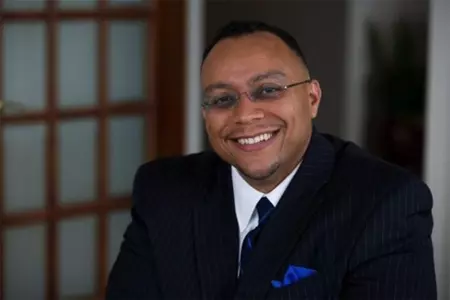
Faculty Appreciation: Juan Concepcion
March 22, 2022 | Boston College Athletics, #ForBoston Files
The American Dream is different for everyone. Juan Concepcion's goal is to make others see how while analyzing why.
CHESTNUT HILL, Mass. -- The concept of the American Dream is deeply embedded in the soul and fabric of society in this country. It's the one thing that's wholly ours, a type of legendary aspiration that can only exist because of the greatest ideals of the United States. It's devoid of race, religion, or creed and lives in the abstract definition of the country's entire declaration, that every person can grow up with the hopes of life, liberty and the pursuit of happiness.
The American Dream, as great as it sounds, is also impossible to fully grasp because it's entirely personal. People's ideas, their goals, rarely match one another even if they all seek the same outcomes. One person, for example, may define success through money and material wealth. Another may define it by how many people they've met and reached in life. A third may go in a completely different direction, while the fourth, the fifth, the sixth and so on all have different interpretations.
Juan Concepcion lives to teach in that metaphysical world. He's lived his own version of the American Dream after his working class, New York City background led to four different degrees from Boston College. A successful attorney, he works for Boston Scientific, a medical lab devices company headquartered in Marlborough, Massachusetts and enjoys a story befitting one interpretation of the dream, but as a part time faculty member at his alma mater, he lives another meaning by teaching students about race and the law in an attempt to better understand the past, the present and the future while helping push forward a more equitable collective American Dream accessible for everyone.
"I came from a working class neighborhood in New York City," he said, "and all the odds, I was told, were stacked against me. There was no reason for me to believe that I could get four degrees, and I was challenged to think about whether I could get one; I ended up with four, which I understand is the most done by a person at BC, and what I learned from those four is that my responsibility is four times that of anybody else. I asked myself what I would do with this great level of education, and what I would do for other people. That's what feeds my professional life."
Understanding that meaning requires a journey through time with a graduate at several levels of the Catholic school experience. Concepcion attended BC after graduating from Cardinal Hayes High School in the South Bronx and chose to attend school in Chestnut Hill because it offered him a familiar, Catholic feeling. It carried the full package for him as a school with elite academics and athletics, and after graduating in 1996 with his bachelor's degree, he stayed at Boston College to get a master's degree in education.
"Being a 'Double Eagle' at that time," he said, "I wanted to be a teacher. So I started teaching United States history and social studies and did that for a couple of years. But I realized that I never had a lot of money growing up. My mom worked a lot, and we managed a lifestyle that was plentiful and nurtured mine and my siblings in the way that we perceived the world. So when it came time, I was a young man, and I decided that it was time to open my wings to make more of myself."
It led him back to Boston College, where becoming both a Triple Eagle and a Quadruple Eagle with two more degrees opened doors to a career practicing law. He was hired by Nixon Peabody, a Global 100 law firm, and began navigating his professional career waters before ultimately joining Boston Scientific as a legal counsel.
Through it all, Concepcion yearned for a return to the classroom. As much as he loved his job, he knew BC taught him about offering society a full-bodied experience, and he wanted to share those experiences with students during their formative years. He specifically understood the vision of the Jesuits and their dual commitment to education and service, and when given the chance, he returned to the university for a fifth time, this time to help others by combining both his knowledge and his passion.
"I learned so much from the school and from the vision of the school," he said. "In my professional life, I was trained at BC to see myself as an actor in society, as someone who takes courage and builds it with the importance of courage. Courage is not the absence of fear, but it's about taking that fear as motivation for action, to change the thing you fear, and that's what I hoped to convey to the students at Boston College."
It's in that respect that he now helps his students understand their own personal dreams and aspirations. Now over 10 years into his time educating the Eagles, he shoulders the responsibility of conveying a message to students because he personally understands what it takes to arrive in that classroom on an academic level. It's his service to return the favor to them while enabling their understanding of better service in a country that offers different dreams for different groups of people.
"Today, I'm teaching kids who were born in 2000, 2001, and 2002," said Concepcion. "I remember those years because I was a grown man at that point, and I understood our country very well. What's really eye opening to me is that every time I get students who come into my class, I am impressed by their intellectual capacity. Over the years, BC students have become better and better and better, but what remains static is their knowledge of our institutions, of our government, and of how our economy works.
"That's what I think is offered in my class," he explained. "I want to take what they know and flip it on its head. As a teacher, you have to peel back some of the concepts, and the only way you're going to be able to do that is if you, yourself, become better and better…I really had every confidence that I was a good lawyer. It was through teaching at BC that helped me to see that I needed to do a lot more work on myself and understanding the law itself."
The result is a class where students are taught how to truly grow as people, and what they know is replaced by an eye-opening discussion and education. They are taught how life dictates the interpretation of those differences and how the ongoing discussion is meant to make them challenge how equality isn't the same for every person, but there is opportunity to make sure those laws, those concepts, are applied the same to any person.
"Boston College is formative education for the whole person," Concepcion said. "It's looking at every aspect of you as an individual and as a person. Beyond that, it's you as an individual with all the gifts and talents that God bestowed upon you within the context of your communities. You, as a human being, are great. You're enough because God said you're enough. But you're only going to be enough within the context of your community if you serve your community with conviction to make sure that problems are solved and avoided the right way.
"Even a kid from a working class community in New York City can get a world class education and can get a corporate executive job with a major company," he said. "If that was the goal, then BC can do that time and time again, but the achievement and all of that is not so much that a poor kid from Washington Heights can come in and do all of those things. It's that that kid can sit and talk about wanting to do more for other people, and I'm committed to that. What BC does well is prepares people to serve in ways that are transformational. It allows people to serve in ways that are impactful, far-reaching, and it opens up [those opportunities] through its network, the access to resources, and to people that can make that happen. That's the beauty of BC's transformative education, the access to the type of influence that can be far-reaching beyond anybody's imagination."
The American Dream, as great as it sounds, is also impossible to fully grasp because it's entirely personal. People's ideas, their goals, rarely match one another even if they all seek the same outcomes. One person, for example, may define success through money and material wealth. Another may define it by how many people they've met and reached in life. A third may go in a completely different direction, while the fourth, the fifth, the sixth and so on all have different interpretations.
Juan Concepcion lives to teach in that metaphysical world. He's lived his own version of the American Dream after his working class, New York City background led to four different degrees from Boston College. A successful attorney, he works for Boston Scientific, a medical lab devices company headquartered in Marlborough, Massachusetts and enjoys a story befitting one interpretation of the dream, but as a part time faculty member at his alma mater, he lives another meaning by teaching students about race and the law in an attempt to better understand the past, the present and the future while helping push forward a more equitable collective American Dream accessible for everyone.
"I came from a working class neighborhood in New York City," he said, "and all the odds, I was told, were stacked against me. There was no reason for me to believe that I could get four degrees, and I was challenged to think about whether I could get one; I ended up with four, which I understand is the most done by a person at BC, and what I learned from those four is that my responsibility is four times that of anybody else. I asked myself what I would do with this great level of education, and what I would do for other people. That's what feeds my professional life."
Understanding that meaning requires a journey through time with a graduate at several levels of the Catholic school experience. Concepcion attended BC after graduating from Cardinal Hayes High School in the South Bronx and chose to attend school in Chestnut Hill because it offered him a familiar, Catholic feeling. It carried the full package for him as a school with elite academics and athletics, and after graduating in 1996 with his bachelor's degree, he stayed at Boston College to get a master's degree in education.
"Being a 'Double Eagle' at that time," he said, "I wanted to be a teacher. So I started teaching United States history and social studies and did that for a couple of years. But I realized that I never had a lot of money growing up. My mom worked a lot, and we managed a lifestyle that was plentiful and nurtured mine and my siblings in the way that we perceived the world. So when it came time, I was a young man, and I decided that it was time to open my wings to make more of myself."
It led him back to Boston College, where becoming both a Triple Eagle and a Quadruple Eagle with two more degrees opened doors to a career practicing law. He was hired by Nixon Peabody, a Global 100 law firm, and began navigating his professional career waters before ultimately joining Boston Scientific as a legal counsel.
Through it all, Concepcion yearned for a return to the classroom. As much as he loved his job, he knew BC taught him about offering society a full-bodied experience, and he wanted to share those experiences with students during their formative years. He specifically understood the vision of the Jesuits and their dual commitment to education and service, and when given the chance, he returned to the university for a fifth time, this time to help others by combining both his knowledge and his passion.
"I learned so much from the school and from the vision of the school," he said. "In my professional life, I was trained at BC to see myself as an actor in society, as someone who takes courage and builds it with the importance of courage. Courage is not the absence of fear, but it's about taking that fear as motivation for action, to change the thing you fear, and that's what I hoped to convey to the students at Boston College."
It's in that respect that he now helps his students understand their own personal dreams and aspirations. Now over 10 years into his time educating the Eagles, he shoulders the responsibility of conveying a message to students because he personally understands what it takes to arrive in that classroom on an academic level. It's his service to return the favor to them while enabling their understanding of better service in a country that offers different dreams for different groups of people.
"Today, I'm teaching kids who were born in 2000, 2001, and 2002," said Concepcion. "I remember those years because I was a grown man at that point, and I understood our country very well. What's really eye opening to me is that every time I get students who come into my class, I am impressed by their intellectual capacity. Over the years, BC students have become better and better and better, but what remains static is their knowledge of our institutions, of our government, and of how our economy works.
"That's what I think is offered in my class," he explained. "I want to take what they know and flip it on its head. As a teacher, you have to peel back some of the concepts, and the only way you're going to be able to do that is if you, yourself, become better and better…I really had every confidence that I was a good lawyer. It was through teaching at BC that helped me to see that I needed to do a lot more work on myself and understanding the law itself."
The result is a class where students are taught how to truly grow as people, and what they know is replaced by an eye-opening discussion and education. They are taught how life dictates the interpretation of those differences and how the ongoing discussion is meant to make them challenge how equality isn't the same for every person, but there is opportunity to make sure those laws, those concepts, are applied the same to any person.
"Boston College is formative education for the whole person," Concepcion said. "It's looking at every aspect of you as an individual and as a person. Beyond that, it's you as an individual with all the gifts and talents that God bestowed upon you within the context of your communities. You, as a human being, are great. You're enough because God said you're enough. But you're only going to be enough within the context of your community if you serve your community with conviction to make sure that problems are solved and avoided the right way.
"Even a kid from a working class community in New York City can get a world class education and can get a corporate executive job with a major company," he said. "If that was the goal, then BC can do that time and time again, but the achievement and all of that is not so much that a poor kid from Washington Heights can come in and do all of those things. It's that that kid can sit and talk about wanting to do more for other people, and I'm committed to that. What BC does well is prepares people to serve in ways that are transformational. It allows people to serve in ways that are impactful, far-reaching, and it opens up [those opportunities] through its network, the access to resources, and to people that can make that happen. That's the beauty of BC's transformative education, the access to the type of influence that can be far-reaching beyond anybody's imagination."


Women's Basketball: Head Coach Kate Popovec-Goss on ACCPM (April 2, 2026)
Friday, April 03
#22 Baseball Defeats #6 North Carolina (April 2, 2026)
Friday, April 03
Kate Popovec-Goss Introductory Press Conference
Thursday, April 02
Football: Bill O'Brien Media Availability (April 1, 2026)
Wednesday, April 01