Boston College Athletics
On The Water and Ready To Go
April 02, 2021 | Rowing, #ForBoston Files
A big year awaits the Eagles at their iconic home on the Charles.
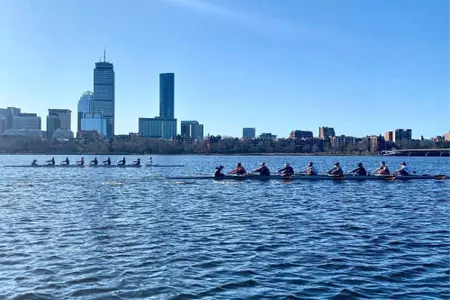
Every New Englander knows the iconic image of a weekend ride down Memorial Drive. The tree-lined road teems with historic brownstones, and the Boston cityscape reflects calmly off the face of the Charles River. It loops through Cambridge with a peaceful bliss broken only by runners attacking their mornings on sidewalks and overpasses between both the Memorial side and across the river on Storrow Drive and Soldiers Field Road.
The centerpiece strokes of a college rowing team's shells are the only altering aspect to the archetypal piece. Easily identified by their distinctive oars, they represent the piece de resistance of the classical, Rockwellian experience. They glide down the river with the colors moving in unison, but the theatrical appearance contrasts with the machine-like work exerted by the athletes.
The rivalries among those teams are fierce and parochial, and their boathouses line the Charles with both their pride and their traditions. Further down the river, past the split from Soldiers Field Road to Nonantum Road, the Harry Parker Boathouse hosts Boston College, a team readying to challenge its peers with a group of young women as strong and competitive as any other team in that recurring scene on the emblematic river.
"Our goal is always to develop fantastic people," said second-year head coach Grace Hollowell. "I think that's built into the core of BC to be men and women for others. The one thing I talk to recruits about is the challenges of what we ask of them here at BC and what we ask of them in a boat where they can learn the character and integrity of what they need to do. Developing young women is a really big piece of what we want to do."
Hollowell's tenure at the helm of the Eagles hasn't exactly been the most normal. Her first year went as strange as possible after her team competed at both the Head of the Housatonic in Connecticut and the world-famous Head of the Charles in the team's backyard. Both the Princeton Chase and the Foot of the Charles were canceled in the fall, and the spring season never restarted after the initial outbreak of the COVID-19 pandemic. It forced the suspension of annual traditions, and rivers fell silent through May with the absence of the schedule and build-up to the equally-suspended Eastern Sprints, ACC Championship and NCAA Championship.
It sent the student-athletes into the same maelstrom as any other sport and upended the way coaches and teams build annual cultures. It forced an unprecedented flexibility in order to compete and brought the team into a new era of appreciating the individual moments on the water. It cost the team's dozen seniors their final season on the water, but the newfound perspective quickly ingrained itself into the BC program.
"I thought about the seniors and how they lost their last two months," Hollowell. "Everyone was pretty upset at that point, but now I talk to our alumni and they're happy they were able to graduate. So much of our team is getting to know one another with mingling, and we have a really big team. You want to get the upper classes to know the younger classes, but with COVID, I think it has been challenging to feel the groups when we're rowing in two shifts. They might not be seeing each other as much as they normally would, but with bigger boats, it has made it easier to get to know one another, to race against one another and be able to race against someone else. We have a really big team and the best group of walk-on athletes that we've had in my time here."
The sheer size of the roster, which runs almost four-dozen deep, is pushing that culture forward even as the team is forced to remain more flexible about how it competes on the water. The Eagles skew younger but have an important core of nine seniors and 11 juniors representing every corner of the country, and everyone brings their own perspective to different brands of rowing.
It specifically offers Hollowell the ability to remain agile in her roster build since the science of building competitive boats requires so many different facets. It builds a uniqueness to both regatta racing and dual meets, and it further stamps the puzzle-building culture of individual athletes working together.
"There are different pieces," she said. "For us, it's three big things. You've got the fitness piece, which is essentially the engine and the horsepower output, and we've got the rowing, which gives us a static measure of fitness. It depends a little bit on whether bigger and smaller rowers are moving their body weight while rowing, but that's just step one.
"The second piece is more challenging," Hollowell continued. "We have to ask if they can apply that in a boat and if they can do it with teammates in a way that allows them to be their best. That's the interesting part about rowing because it's a little bit of science and a little bit of art as well. That's the fun part about coaching because data can tell you to put your eight strongest kids in a boat together, but it might not work. A smaller kid might not be as good individually but is allowing everyone else around them to grow to their full potential. With our freshman class that came in, going from a high school program and some kids who have never rowed before, they're all learning how to row at BC with a different learning curve for everyone."
It's put the team back on the water in a year unlike anything anyone's ever experienced. COVID-19 canceled traditional events and cup races, and the Head of the Charles, the largest two-day regatta in the world, was canceled for the first time since 1996 and only the second time ever. The fall season, normally a staple among the colorful foliage of Boston, didn't happen at all.
Yet BC can still row on the Charles against its Boston-based neighbors and experience the tradition and rivalry of being a Massachusetts rowing program. It will race against UConn and Holy Cross in the Irving-Christensen Cup in mid-April and will battle both Rhode Island and UMass on its home waters. One road trip to North Carolina still awaits, as does the ACC Championship in mid-May at Clemson.
"It's going to be really interesting this year," Hollowell said. "Everyone's in a slightly different position. Maybe your top kid had to be out, or maybe you haven't gotten to practice your lineup as much. There are so many factors that come in this year, but the goal is always to beat the crew next to you. A lot of it is going to be how we can be better, and the great thing is that our times are consistent even when we take into account where we're rowing, the current, the temperature and the wind.
"We'll have dual races, which are pretty common, especially in Boston," she added. "We still have a couple of cup races. We want to make it into the grand final at the ACC and move our way up the rankings. There are certainly teams we can beat, and we can get into that top of the teams on the Charles - the BUs, Northeasterns and MITs that are really big rivalries. We can put ourselves in a position to challenge for those cups, especially when it gets to the fall with the Head of the Charles. That's one our team loves in particular because it's our home event, and there is program-building momentum that when we put in the work, the results are going to come."
BC opens up its schedule this weekend when it rows against Coast Guard in a matchup originally scheduled against Boston University. A race against the Terriers is set for next weekend on April 10 with Rhode Island coming to the Charles on April 17, one day before the race against UConn and Holy Cross. The Eagles will then wrap up the season at the two-day Wheeler Invite in North Carolina before a May 1 finale against UMass. The ACC Championship is scheduled for May 13 and 14 at Clemson.
The centerpiece strokes of a college rowing team's shells are the only altering aspect to the archetypal piece. Easily identified by their distinctive oars, they represent the piece de resistance of the classical, Rockwellian experience. They glide down the river with the colors moving in unison, but the theatrical appearance contrasts with the machine-like work exerted by the athletes.
The rivalries among those teams are fierce and parochial, and their boathouses line the Charles with both their pride and their traditions. Further down the river, past the split from Soldiers Field Road to Nonantum Road, the Harry Parker Boathouse hosts Boston College, a team readying to challenge its peers with a group of young women as strong and competitive as any other team in that recurring scene on the emblematic river.
"Our goal is always to develop fantastic people," said second-year head coach Grace Hollowell. "I think that's built into the core of BC to be men and women for others. The one thing I talk to recruits about is the challenges of what we ask of them here at BC and what we ask of them in a boat where they can learn the character and integrity of what they need to do. Developing young women is a really big piece of what we want to do."
Hollowell's tenure at the helm of the Eagles hasn't exactly been the most normal. Her first year went as strange as possible after her team competed at both the Head of the Housatonic in Connecticut and the world-famous Head of the Charles in the team's backyard. Both the Princeton Chase and the Foot of the Charles were canceled in the fall, and the spring season never restarted after the initial outbreak of the COVID-19 pandemic. It forced the suspension of annual traditions, and rivers fell silent through May with the absence of the schedule and build-up to the equally-suspended Eastern Sprints, ACC Championship and NCAA Championship.
It sent the student-athletes into the same maelstrom as any other sport and upended the way coaches and teams build annual cultures. It forced an unprecedented flexibility in order to compete and brought the team into a new era of appreciating the individual moments on the water. It cost the team's dozen seniors their final season on the water, but the newfound perspective quickly ingrained itself into the BC program.
"I thought about the seniors and how they lost their last two months," Hollowell. "Everyone was pretty upset at that point, but now I talk to our alumni and they're happy they were able to graduate. So much of our team is getting to know one another with mingling, and we have a really big team. You want to get the upper classes to know the younger classes, but with COVID, I think it has been challenging to feel the groups when we're rowing in two shifts. They might not be seeing each other as much as they normally would, but with bigger boats, it has made it easier to get to know one another, to race against one another and be able to race against someone else. We have a really big team and the best group of walk-on athletes that we've had in my time here."
The sheer size of the roster, which runs almost four-dozen deep, is pushing that culture forward even as the team is forced to remain more flexible about how it competes on the water. The Eagles skew younger but have an important core of nine seniors and 11 juniors representing every corner of the country, and everyone brings their own perspective to different brands of rowing.
It specifically offers Hollowell the ability to remain agile in her roster build since the science of building competitive boats requires so many different facets. It builds a uniqueness to both regatta racing and dual meets, and it further stamps the puzzle-building culture of individual athletes working together.
"There are different pieces," she said. "For us, it's three big things. You've got the fitness piece, which is essentially the engine and the horsepower output, and we've got the rowing, which gives us a static measure of fitness. It depends a little bit on whether bigger and smaller rowers are moving their body weight while rowing, but that's just step one.
"The second piece is more challenging," Hollowell continued. "We have to ask if they can apply that in a boat and if they can do it with teammates in a way that allows them to be their best. That's the interesting part about rowing because it's a little bit of science and a little bit of art as well. That's the fun part about coaching because data can tell you to put your eight strongest kids in a boat together, but it might not work. A smaller kid might not be as good individually but is allowing everyone else around them to grow to their full potential. With our freshman class that came in, going from a high school program and some kids who have never rowed before, they're all learning how to row at BC with a different learning curve for everyone."
It's put the team back on the water in a year unlike anything anyone's ever experienced. COVID-19 canceled traditional events and cup races, and the Head of the Charles, the largest two-day regatta in the world, was canceled for the first time since 1996 and only the second time ever. The fall season, normally a staple among the colorful foliage of Boston, didn't happen at all.
Yet BC can still row on the Charles against its Boston-based neighbors and experience the tradition and rivalry of being a Massachusetts rowing program. It will race against UConn and Holy Cross in the Irving-Christensen Cup in mid-April and will battle both Rhode Island and UMass on its home waters. One road trip to North Carolina still awaits, as does the ACC Championship in mid-May at Clemson.
"It's going to be really interesting this year," Hollowell said. "Everyone's in a slightly different position. Maybe your top kid had to be out, or maybe you haven't gotten to practice your lineup as much. There are so many factors that come in this year, but the goal is always to beat the crew next to you. A lot of it is going to be how we can be better, and the great thing is that our times are consistent even when we take into account where we're rowing, the current, the temperature and the wind.
"We'll have dual races, which are pretty common, especially in Boston," she added. "We still have a couple of cup races. We want to make it into the grand final at the ACC and move our way up the rankings. There are certainly teams we can beat, and we can get into that top of the teams on the Charles - the BUs, Northeasterns and MITs that are really big rivalries. We can put ourselves in a position to challenge for those cups, especially when it gets to the fall with the Head of the Charles. That's one our team loves in particular because it's our home event, and there is program-building momentum that when we put in the work, the results are going to come."
BC opens up its schedule this weekend when it rows against Coast Guard in a matchup originally scheduled against Boston University. A race against the Terriers is set for next weekend on April 10 with Rhode Island coming to the Charles on April 17, one day before the race against UConn and Holy Cross. The Eagles will then wrap up the season at the two-day Wheeler Invite in North Carolina before a May 1 finale against UMass. The ACC Championship is scheduled for May 13 and 14 at Clemson.
Saturday, October 03
Saturday, October 03
Thursday, October 01
Thursday, October 01