Boston College Athletics
Four Downs: Virginia Tech (1993)
April 17, 2020 | Football, #ForBoston Files
Glenn Foley shattered some BC record as the Eagles rolled against the Hokies.
Boston College's 1993 win over Virginia Tech left a deep resonation within the Big East's football fabric. It was the first season of an official round robin in the conference, and many considered the Hokies and Eagles part of the clear-cut tier behind Miami. Both teams lost to the Hurricanes earlier that season, with Virginia Tech having previously lost to West Virginia, which would later finish the season at BC. That meant the winner would still have a shot at the conference's top tier with the Eagles harboring an outside shot at the conference championship.
The win ended the conversation entirely and vaulted BC over Virginia Tech into a much more translucent third place. It pushed the Hokies out of the national rankings, replaced instead by the Eagles, and it gave the winners the inside track to a more prestigious bowl in the Big East's first year.
"We think BC's certainly one of the best teams in the Big East," Brian Flajole said. "We'd love to have BC. We were talking in the press box about the possibility of having Boston College and Glenn Foley matched against Georgia and Eric Zeier. That'd be a really exciting game to watch."
Flajole was the executive director of the Carquest Bowl, a game scheduled for New Year's Day, 1994. It came into existence in 1990 as the Blockbuster Bowl and is the same game as the current day's Camping World Bowl. Its first three seasons pitted two nationally-ranked teams against one another and twice featured top 10 teams, including the 1990 inaugural game between No. 6 Florida State and No. 7 Penn State.
This is still a highly-regarded game, but getting into it in 1993 required more substantial work. The Bowl Coalition formed the year before to help determine a national champion, but only 13 games existed outside of its six games. The Fiesta Bowl, Cotton Bowl, Orange Bowl and Sugar Bowl comprised Tier I, while the John Hancock Bowl (now the Sun Bowl) and the Gator Bowl (now the Taxslayer Bowl) made up a second tier.
The Rose Bowl was not part of the Bowl Coalition and had tie-ins with the Big Ten and Pac-10 champions, so that really only left a dozen or so games for invitation-only teams. BC and Virginia Tech both finished the year 9-3, and the Hokies, who rallied to defeat both Syracuse and Virginia, went to the Independence Bowl in Shreveport.
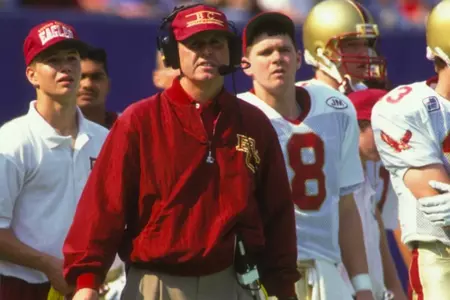
"Every game we've had has been substantially important football games for a lot of reasons," head coach Tom Coughlin said. "Each win is a big game in its own right, and this one is just another in the terms of games we had to win to create opportunities for ourselves. That's basically what we've done."
This win really boosted BC's profile in 1993, and the team cemented its trip by later upsetting No. 1 Notre Dame on David Gordon's kick. The Carquest Bowl eventually invited BC to play against Virginia, which finished third in the ACC. Glenn Foley, who lit up the Hokies for 448 yards and three touchdowns, went for 391 in that game, and the Eagles easily won, 31-13, to finish the season with a 9-3 record and a better national ranking than Miami, which won the teams' opening week game.
Here are the other takeaways from the BC win in November, 1993:
*****
First Down: Foley's Flight
Glenn Foley and Maurice DeShazo represented two of the talented college quarterbacks calling the Big East home during the league's early years. Both fit their offenses perfectly, and both displayed an exhibition for each other on the Alumni Stadium turf in 1993.
Foley went 21-of-29 for 448 yards and three touchdowns without an interception to become the first BC quarterback with 2,000 yards in each of his four seasons under center. He torched the Hokies, and he displayed an intellectual side of his game baked into the game plan by his coaching staff. It utilized his vision and perception, a rare breakaway from the passionate, intense plays he normally made by sheer will.
"I'd say I checked off about 50 or 60 percent of the plays," he said afterwards. "But it wasn't me going up there and changing the play at the line of scrimmage. I was just checking off the options I had."
The game marked a number of achievements for the New Jersey firearm. He recorded the most yards passing in a BC victory since the Hail Flutie game against Miami in 1984. It was, at the time, just the tenth 400-yard game, all thrown by either Foley, Doug Flutie or Shawn Halloran. He joined Flutie and Halloran with multiple 400-yard games in what was his program-record 41st start. It was also the second time in the Foley era that BC went over 600 yards of offense, joining the 1982 game against Penn State.
"I'm most proud of (the consecutive starts record) because I've taken every snap since I've been here," Foley said after the game. "Except for my first game, which I didn't start, I haven't missed a play."
*****
Second Down: Ivan the Terrible
Wide receiver Ivan Boyd only receives scant mentions in the Boston College record book. He isn't one of the team's all-time leading receivers and doesn't hold the most yards in a single game. He isn't atop the touchdown list or reception list, and so many more fans and analysts talk about tight end Pete Mitchell when they discuss that era. He's a forgotten hero, which is why the Virginia Tech game serves as a healthy reminder of game-breaking abilities.
Boyd went for 162 yards and two scores against Virginia Tech, with his long reception coming off of a wide receiver screen catch and run for 68 yards to break open the score in the fourth quarter. It bookended his first quarter touchdown, which came after a 50-yard screen pass reception that could have ended in the end zone.
"The first time, the linemen were yelling that I should have followed them," Boyd said after the win. "The next time, I looked to my right and thought, 'Wow, they weren't joking.'"
The performance reflected the explosiveness first displayed earlier in the season against Syracuse. Boyd posted numbers similar to Marvin Harrison in that win over the nationally-ranked Orange, but he had only three catches combined in the team's two wins preceding Virginia Tech. That changed dramatically against the Hokies, when Foley read the defense and audibled into screen passes. Boyd made five catches, one less than both Keith Miller and Pete Mitchell, but remained the more explosive option.
"Glenn's just been throwing the ball unbelievably well," he said after the Virginia Tech game. "He's just sitting back there and picking and choosing his receivers. It helps when you're throwing the ball to one or two more guys because (defenses) can't cover everybody."
Boyd's high-water mark came in that Virginia Tech game. He missed the Carquest Bowl with an injury and wrapped up his senior season with 21 receptions and five scores. Even so, that performance from 1993 still resonates. No Eagle in the past 15 years touched that number in a victory, with Kenyatta Watson coming closest with 159 yards in a 1996 win against Cincinnati, so he's not a lost name that played in an era nobody ever forgets.
*****
Third Down: Turkey Gobbler
Boston College threatened to turn this game into a blowout twice before Maurice DeShazo led the Hokies back into things. He ran an 11-yard touchdown run to start the second quarter when the Eagles led, 14-0, and hit Cornelius White to set up DeWayne Thomas for a score when BC pushed the game back to 28-7.
In total, DeShazo threw for 174 yards and a score and ran for 54 yards and a touchdown in a two-way kind of game. He threw two interceptions but largely didn't hurt the Hokies, though his 11-of-22 efficiency struggled to keep up with Foley's laser rocket passing. He couldn't overcome BC's offensive explosion, but he pushed the blowout out as long as possible before the fourth quarter.
DeShazo is often lost in the quarterback greatness that followed him. He threw for more than 2,000 yards in 1993 and 1994 but watched his touchdown-to-interception ratio struggle between the two seasons. Still, he led the Hokies to consecutive eight-win seasons and helped push the program into second place in the Big East by the time he left in 1994.
Beamer replaced him late in the BC game with Jim Druckenmiller, the next starting quarterback after his departure. He threw for 105 yards with a 57-yard touchdown pass to Bryan Still against the Eagles to foreshadow his future exploits. He assumed the starting job in 1995 and immediately won the Big East, repeating in 1996 with an All-Big East performance. San Francisco saw him fit to draft in the first round in 1997, but his professional career derailed shortly thereafter, resulting in draft bust status.
Druckenmiller kicked off a long line of successful Virginia Tech starting quarterbacks, and he is widely recognized as the cornerstone of what became Michael Vick, Bryan Randall, Sean Glennon, Tyrod Taylor, Logan Thomas, Josh Jackson and others. DeShazo is the outlier in that group and is usually left off the list despite the fact that he led the Hokies into the Big East and had them in contention for a conference championship until the late stages of 1993.
*****
Fourth Down: Beamer over Coughlin?
It's hard to imagine a world where Tom Coughlin wasn't Boston College's first choice for the head coaching position after it fired Jack Bicknell. The former BC assistant won Super Bowls with Bill Parcells before earning two Vince Lombardi trophies on his own. He successfully stood up the Jacksonville Jaguars as an expansion franchise and will, without question, enshrine in the Pro Football Hall of Fame as one of the game's biggest legends.
He was not, however, Boston College's first selection for its head coaching vacancy in 1990. The Eagles fired Jack Bicknell after a four-win season and looked to enter the Big East's new football league with a hot commodity in the coaching search. Athletic director Chet Gladchuk went outside New England and the Northeast for his interviewing process and ultimately settled his first offer on Frank Beamer.
Beamer was known at the time for his success at Murray State in Division I-AA. He won at least seven games in four of his five seasons and finished his tenure with three straight national rankings and a national tournament appearance in his final season in 1986. He took over Virginia Tech in 1987 and resurrected the program after two poor seasons as an Independent, ultimately turning it into a six-win team when the Big East began play at the turn of the decade. It's a little funny to think about now, but that gave him a natural stepping stone to the Boston College job given the success of the Eagles over the prior five seasons.
"I was very impressed with the people in the administration there," Beamer said. "I was very impressed with the place. I think it's a great school and a beautiful place, but they got the right guy at Boston College.
Beamer interviewed with Gladchuk, who extended an offer that was declined. The BC athletic director moved on to William & Mary head coach Jimmye Laycock, who accepted a contract before backing out of the position less than 24 hours later. That led Gladchuk back to Coughlin, who accepted his first head coaching position and returned to Chestnut Hill, where he was originally an assistant.
"They got the right coach at Boston College," Beamer said before that 1993 game. "I don't think there's any question about that. Tom Coughlin (did) a tremendous job there."
It's really interesting to think about how timelines diverge to break from the space-time continuum. Frank Beamer turned Virginia Tech into a national championship caliber program and coached the Hokies to three conference championships over the next decade. He ultimately turned Blacksburg into a football destination on par and shifted the power within his own state. It turned the program into a no-brainer decision for the ACC's expansion, and the Hokies fit seamlessly into the newly-configured divisional format. They remain a fixture on the Boston College schedule as a permanent cross-over to the Coastal Division. There's no reason to ever be upset by the past, especially given what Tom Coughlin accomplished, but it's still really interesting to think about what could have happened if Beamer accepted that position and came to Boston instead of remaining in Blacksburg.
*****
Point After: That Week in Football
The Big East's strength and talent chasm was a consistent thorn throughout its football conference's first decade of existence. Miami was a national championship contender, and West Virginia and Virginia Tech were rising football powers throughout the early 1990s. Boston College, Syracuse and Pittsburgh represented the northeast with pride, but their counterparts at Rutgers and Temple never compared until the league's post-realignment run.
The BC-Virginia Tech game was an instant classic, but the rest of the Big East wasn't nearly as competitive. Syracuse and West Virginia combined for 110 points against Temple and Rutgers, with the Owls in particular dropping a 52-3 result for their eighth consecutive loss. It was their 16th straight defeat against Big East opponents dating back to the informal start and part of a streak that almost reached 30 games until a win over Pitt in 1995.
As for West Virginia, the 58-22 win over Rutgers handed the Scarlet Knights their worst loss in 41 years. It continued the Mountaineers' run to an undefeated season and the Big East championship. It was an epic season in Morgantown where the team scored 30 points or more in eight of its first nine games and went over 40 six different times. That said, West Virginia ran into two roadblocks in its last two games and only squeaked past Miami and BC by a combined six points before being blown out by Florida in the Sugar Bowl, 41-7.
The anticlimactic week didn't occur in other leagues. Unranked Kansas scored a touchdown with less than a minute remaining against No. 6 Nebraska but decided to go for two. The Jayhawks missed and lost, 21-20, to Tommie Frazier and the Cornhuskers.
That wasn't as big of a nightmare as what happened to Alabama. The No. 5 Crimson Tide hadn't lost since September 14, 1991 when it played LSU at home, but the Tigers pulled off a massive upset with four second-half interceptions to win, 17-13. It squarely put No. 8 Auburn in the driver's seat in the SEC West.
Those results didn't really matter nationally because everyone knew who they were chasing. No. 1 Florida State easily handled Maryland in the ACC, 49-20, to set up the Game of the Century the next week at No. 2 Notre Dame. We all know how that turned out (smile emoji).
There wasn't much on the local college football radar, though it's worth noting Boston University's 61-33 blowout over Buffalo. In Amherst, UMass defeated Richmond, 29-24, in Jim Reid's return to the stadium he once called home, while UConn sped past Rhode Island, 41-9, in the Yankee Conference.
It was a great week on the high school docket in Massachusetts. Wellesley defeated Walpole for the second consecutive season after losing the previous 23 meetings to clinch its second straight league championship. Winthrop and North Attleboro likewise stamped tickets to the postseason, while Rob Konrad scored three touchdowns to lead St. John's Prep over St. John's Shrewsbury.
In boxing, Evander Holyfield defeated Riddick Bowe to regain the world heavyweight championship in Las Vegas. The fight is best remembered for a parachutist who landed in the middle of the ring in the seventh round with a fan strapped to his back.
All quotes originally provided to the Boston Globe.
The win ended the conversation entirely and vaulted BC over Virginia Tech into a much more translucent third place. It pushed the Hokies out of the national rankings, replaced instead by the Eagles, and it gave the winners the inside track to a more prestigious bowl in the Big East's first year.
"We think BC's certainly one of the best teams in the Big East," Brian Flajole said. "We'd love to have BC. We were talking in the press box about the possibility of having Boston College and Glenn Foley matched against Georgia and Eric Zeier. That'd be a really exciting game to watch."
Flajole was the executive director of the Carquest Bowl, a game scheduled for New Year's Day, 1994. It came into existence in 1990 as the Blockbuster Bowl and is the same game as the current day's Camping World Bowl. Its first three seasons pitted two nationally-ranked teams against one another and twice featured top 10 teams, including the 1990 inaugural game between No. 6 Florida State and No. 7 Penn State.
This is still a highly-regarded game, but getting into it in 1993 required more substantial work. The Bowl Coalition formed the year before to help determine a national champion, but only 13 games existed outside of its six games. The Fiesta Bowl, Cotton Bowl, Orange Bowl and Sugar Bowl comprised Tier I, while the John Hancock Bowl (now the Sun Bowl) and the Gator Bowl (now the Taxslayer Bowl) made up a second tier.
The Rose Bowl was not part of the Bowl Coalition and had tie-ins with the Big Ten and Pac-10 champions, so that really only left a dozen or so games for invitation-only teams. BC and Virginia Tech both finished the year 9-3, and the Hokies, who rallied to defeat both Syracuse and Virginia, went to the Independence Bowl in Shreveport.
"Every game we've had has been substantially important football games for a lot of reasons," head coach Tom Coughlin said. "Each win is a big game in its own right, and this one is just another in the terms of games we had to win to create opportunities for ourselves. That's basically what we've done."
This win really boosted BC's profile in 1993, and the team cemented its trip by later upsetting No. 1 Notre Dame on David Gordon's kick. The Carquest Bowl eventually invited BC to play against Virginia, which finished third in the ACC. Glenn Foley, who lit up the Hokies for 448 yards and three touchdowns, went for 391 in that game, and the Eagles easily won, 31-13, to finish the season with a 9-3 record and a better national ranking than Miami, which won the teams' opening week game.
Here are the other takeaways from the BC win in November, 1993:
*****
First Down: Foley's Flight
Glenn Foley and Maurice DeShazo represented two of the talented college quarterbacks calling the Big East home during the league's early years. Both fit their offenses perfectly, and both displayed an exhibition for each other on the Alumni Stadium turf in 1993.
Foley went 21-of-29 for 448 yards and three touchdowns without an interception to become the first BC quarterback with 2,000 yards in each of his four seasons under center. He torched the Hokies, and he displayed an intellectual side of his game baked into the game plan by his coaching staff. It utilized his vision and perception, a rare breakaway from the passionate, intense plays he normally made by sheer will.
"I'd say I checked off about 50 or 60 percent of the plays," he said afterwards. "But it wasn't me going up there and changing the play at the line of scrimmage. I was just checking off the options I had."
The game marked a number of achievements for the New Jersey firearm. He recorded the most yards passing in a BC victory since the Hail Flutie game against Miami in 1984. It was, at the time, just the tenth 400-yard game, all thrown by either Foley, Doug Flutie or Shawn Halloran. He joined Flutie and Halloran with multiple 400-yard games in what was his program-record 41st start. It was also the second time in the Foley era that BC went over 600 yards of offense, joining the 1982 game against Penn State.
"I'm most proud of (the consecutive starts record) because I've taken every snap since I've been here," Foley said after the game. "Except for my first game, which I didn't start, I haven't missed a play."
*****
Second Down: Ivan the Terrible
Wide receiver Ivan Boyd only receives scant mentions in the Boston College record book. He isn't one of the team's all-time leading receivers and doesn't hold the most yards in a single game. He isn't atop the touchdown list or reception list, and so many more fans and analysts talk about tight end Pete Mitchell when they discuss that era. He's a forgotten hero, which is why the Virginia Tech game serves as a healthy reminder of game-breaking abilities.
Boyd went for 162 yards and two scores against Virginia Tech, with his long reception coming off of a wide receiver screen catch and run for 68 yards to break open the score in the fourth quarter. It bookended his first quarter touchdown, which came after a 50-yard screen pass reception that could have ended in the end zone.
"The first time, the linemen were yelling that I should have followed them," Boyd said after the win. "The next time, I looked to my right and thought, 'Wow, they weren't joking.'"
The performance reflected the explosiveness first displayed earlier in the season against Syracuse. Boyd posted numbers similar to Marvin Harrison in that win over the nationally-ranked Orange, but he had only three catches combined in the team's two wins preceding Virginia Tech. That changed dramatically against the Hokies, when Foley read the defense and audibled into screen passes. Boyd made five catches, one less than both Keith Miller and Pete Mitchell, but remained the more explosive option.
"Glenn's just been throwing the ball unbelievably well," he said after the Virginia Tech game. "He's just sitting back there and picking and choosing his receivers. It helps when you're throwing the ball to one or two more guys because (defenses) can't cover everybody."
Boyd's high-water mark came in that Virginia Tech game. He missed the Carquest Bowl with an injury and wrapped up his senior season with 21 receptions and five scores. Even so, that performance from 1993 still resonates. No Eagle in the past 15 years touched that number in a victory, with Kenyatta Watson coming closest with 159 yards in a 1996 win against Cincinnati, so he's not a lost name that played in an era nobody ever forgets.
*****
Third Down: Turkey Gobbler
Boston College threatened to turn this game into a blowout twice before Maurice DeShazo led the Hokies back into things. He ran an 11-yard touchdown run to start the second quarter when the Eagles led, 14-0, and hit Cornelius White to set up DeWayne Thomas for a score when BC pushed the game back to 28-7.
In total, DeShazo threw for 174 yards and a score and ran for 54 yards and a touchdown in a two-way kind of game. He threw two interceptions but largely didn't hurt the Hokies, though his 11-of-22 efficiency struggled to keep up with Foley's laser rocket passing. He couldn't overcome BC's offensive explosion, but he pushed the blowout out as long as possible before the fourth quarter.
DeShazo is often lost in the quarterback greatness that followed him. He threw for more than 2,000 yards in 1993 and 1994 but watched his touchdown-to-interception ratio struggle between the two seasons. Still, he led the Hokies to consecutive eight-win seasons and helped push the program into second place in the Big East by the time he left in 1994.
Beamer replaced him late in the BC game with Jim Druckenmiller, the next starting quarterback after his departure. He threw for 105 yards with a 57-yard touchdown pass to Bryan Still against the Eagles to foreshadow his future exploits. He assumed the starting job in 1995 and immediately won the Big East, repeating in 1996 with an All-Big East performance. San Francisco saw him fit to draft in the first round in 1997, but his professional career derailed shortly thereafter, resulting in draft bust status.
Druckenmiller kicked off a long line of successful Virginia Tech starting quarterbacks, and he is widely recognized as the cornerstone of what became Michael Vick, Bryan Randall, Sean Glennon, Tyrod Taylor, Logan Thomas, Josh Jackson and others. DeShazo is the outlier in that group and is usually left off the list despite the fact that he led the Hokies into the Big East and had them in contention for a conference championship until the late stages of 1993.
*****
Fourth Down: Beamer over Coughlin?
It's hard to imagine a world where Tom Coughlin wasn't Boston College's first choice for the head coaching position after it fired Jack Bicknell. The former BC assistant won Super Bowls with Bill Parcells before earning two Vince Lombardi trophies on his own. He successfully stood up the Jacksonville Jaguars as an expansion franchise and will, without question, enshrine in the Pro Football Hall of Fame as one of the game's biggest legends.
He was not, however, Boston College's first selection for its head coaching vacancy in 1990. The Eagles fired Jack Bicknell after a four-win season and looked to enter the Big East's new football league with a hot commodity in the coaching search. Athletic director Chet Gladchuk went outside New England and the Northeast for his interviewing process and ultimately settled his first offer on Frank Beamer.
Beamer was known at the time for his success at Murray State in Division I-AA. He won at least seven games in four of his five seasons and finished his tenure with three straight national rankings and a national tournament appearance in his final season in 1986. He took over Virginia Tech in 1987 and resurrected the program after two poor seasons as an Independent, ultimately turning it into a six-win team when the Big East began play at the turn of the decade. It's a little funny to think about now, but that gave him a natural stepping stone to the Boston College job given the success of the Eagles over the prior five seasons.
"I was very impressed with the people in the administration there," Beamer said. "I was very impressed with the place. I think it's a great school and a beautiful place, but they got the right guy at Boston College.
Beamer interviewed with Gladchuk, who extended an offer that was declined. The BC athletic director moved on to William & Mary head coach Jimmye Laycock, who accepted a contract before backing out of the position less than 24 hours later. That led Gladchuk back to Coughlin, who accepted his first head coaching position and returned to Chestnut Hill, where he was originally an assistant.
"They got the right coach at Boston College," Beamer said before that 1993 game. "I don't think there's any question about that. Tom Coughlin (did) a tremendous job there."
It's really interesting to think about how timelines diverge to break from the space-time continuum. Frank Beamer turned Virginia Tech into a national championship caliber program and coached the Hokies to three conference championships over the next decade. He ultimately turned Blacksburg into a football destination on par and shifted the power within his own state. It turned the program into a no-brainer decision for the ACC's expansion, and the Hokies fit seamlessly into the newly-configured divisional format. They remain a fixture on the Boston College schedule as a permanent cross-over to the Coastal Division. There's no reason to ever be upset by the past, especially given what Tom Coughlin accomplished, but it's still really interesting to think about what could have happened if Beamer accepted that position and came to Boston instead of remaining in Blacksburg.
*****
Point After: That Week in Football
The Big East's strength and talent chasm was a consistent thorn throughout its football conference's first decade of existence. Miami was a national championship contender, and West Virginia and Virginia Tech were rising football powers throughout the early 1990s. Boston College, Syracuse and Pittsburgh represented the northeast with pride, but their counterparts at Rutgers and Temple never compared until the league's post-realignment run.
The BC-Virginia Tech game was an instant classic, but the rest of the Big East wasn't nearly as competitive. Syracuse and West Virginia combined for 110 points against Temple and Rutgers, with the Owls in particular dropping a 52-3 result for their eighth consecutive loss. It was their 16th straight defeat against Big East opponents dating back to the informal start and part of a streak that almost reached 30 games until a win over Pitt in 1995.
As for West Virginia, the 58-22 win over Rutgers handed the Scarlet Knights their worst loss in 41 years. It continued the Mountaineers' run to an undefeated season and the Big East championship. It was an epic season in Morgantown where the team scored 30 points or more in eight of its first nine games and went over 40 six different times. That said, West Virginia ran into two roadblocks in its last two games and only squeaked past Miami and BC by a combined six points before being blown out by Florida in the Sugar Bowl, 41-7.
The anticlimactic week didn't occur in other leagues. Unranked Kansas scored a touchdown with less than a minute remaining against No. 6 Nebraska but decided to go for two. The Jayhawks missed and lost, 21-20, to Tommie Frazier and the Cornhuskers.
That wasn't as big of a nightmare as what happened to Alabama. The No. 5 Crimson Tide hadn't lost since September 14, 1991 when it played LSU at home, but the Tigers pulled off a massive upset with four second-half interceptions to win, 17-13. It squarely put No. 8 Auburn in the driver's seat in the SEC West.
Those results didn't really matter nationally because everyone knew who they were chasing. No. 1 Florida State easily handled Maryland in the ACC, 49-20, to set up the Game of the Century the next week at No. 2 Notre Dame. We all know how that turned out (smile emoji).
There wasn't much on the local college football radar, though it's worth noting Boston University's 61-33 blowout over Buffalo. In Amherst, UMass defeated Richmond, 29-24, in Jim Reid's return to the stadium he once called home, while UConn sped past Rhode Island, 41-9, in the Yankee Conference.
It was a great week on the high school docket in Massachusetts. Wellesley defeated Walpole for the second consecutive season after losing the previous 23 meetings to clinch its second straight league championship. Winthrop and North Attleboro likewise stamped tickets to the postseason, while Rob Konrad scored three touchdowns to lead St. John's Prep over St. John's Shrewsbury.
In boxing, Evander Holyfield defeated Riddick Bowe to regain the world heavyweight championship in Las Vegas. The fight is best remembered for a parachutist who landed in the middle of the ring in the seventh round with a fan strapped to his back.
All quotes originally provided to the Boston Globe.
Thursday, June 04
Thursday, June 04
Wednesday, June 03
Wednesday, June 03