Boston College Athletics
First Steps From "In Shape" to "Game Shape"
August 04, 2019 | Football, #ForBoston Files
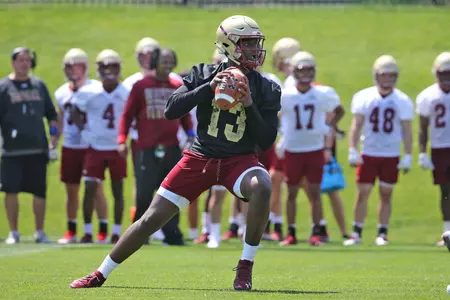
The first two practices began the process of molding BC back to football condition.
The first two days of the college football preseason brought an undeniable energy to Boston College's Fish Field House. It created a palpable excitement that provided the backdrop for the days of position-group drills, itself a launchpad for the upcoming season's hopeful success. It created a heightened anticipation even as it remained a tease with helmets providing the contrast to the no-pads workouts in the early August heat.
It could have felt like an extension of spring practice, but everyone understood that there was a greater mission to these particular sessions. An offseason spent in the weight room or in recovery is now about a changeover into "football shape."
"Right now, we're not using pads, so (practice) is about working on technique and owning the scheme at 100-percent," running back AJ Dillon said. "Everyone is really focused on figuring out what 'your job' means and how we're supposed to do that job to the best of our abilities."
The transformation from simply being in shape to "football game shape" isn't something that happens overnight. The NCAA acclimation period provides a week-long adjustment that gradually sets players back into full pads. Shoulder pads will be added on Sunday after two days' worth of helmets-only practices, followed by a couple of shell days before full pads yield full contact.
It's a transitional process that ultimately provides coaches with the opportunity to work on technique and skill as opposed to brute physicality. The first two days are a litmus test to recalibrate and regroup, even as they stand as a continuation of the summer practice and spring-ball development sessions.
"The rules allow us to meet with everyone (during the offseason), so we do a lot of work with them," head coach Steve Addazio said. "But football isn't like (other sports). You have to play the game, and that's why preseason camp is so critically important. There's only so many things that you can do on your own that gives you fashions of what happens in real time and real speed."
It's a particular pivot for a BC team formulating the foundation of the upcoming season. There's a desire to continue trending upwards after what happened in 2018, but there's also a sense that every season is completely different. The first two days are a stress test for the offseason strength and conditioning program, even though there's a general understanding that a team is different in March as it will be in August, with further changes before September, October and beyond.
"I thought everyone came into camp in great shape," Addazio said. "There was a lack of attention to detail on the first day, but it's not necessarily a lack of effort. Day Two was significantly better, but that's pretty standard. Day One, no matter how much you train or what you do, is hard to simulate what happens when you play football. (Day Two) is significantly better than (Day One), and it creates a graph that (trends upwards)."
"Our strength and conditioning staff did a great job," linebacker John Lamot said. "They really honed in on taking care of our bodies. Everything that we do (in training) is either going to help the team or take away from the team. Everything that we do on our own time is putting in that time so when we come to camp, we're not going through the drastic changes to our bodies."
All of that comes despite an understanding about future "dog days." The first two practices build to the first full-contact practices, which eventually lead into the first scrimmages. At some point, hitting the same teammates and scrimmaging the same schemes will create weary rivalries, and the same drills will become mundane. There is always that one practice where the coaches are left feeling hotter than the temperature gauge.
"There's the first contact day, and the offense will often struggle because it has to adjust to driving through contact," Addazio said. "Then (it will have to) push ahead again. I've never seen it any different anywhere I've ever been.
"If you're not involved in it, you don't understand it but nor could you," he said. "The speed of the physicality of the game is so quick because people make snap decisions on the field. Having not done that, it takes a while to get used to the speed of the game."
"We all come (into camp) in shape," Lamot said. "But that first game, it's still going to hit. Some of that's nerves, but if you are physically conditioned, you can still execute at a high level."
Nobody really seemed to worry about those days, though, in the first two practices. Technique instruction reigned supreme, and drills allowed players to explore what they learned in the offseason. Everyone seemed to simply embrace the opportunity under an umbrella of understanding that every day is a continuation of the previous workout or session, even as it stands as the first step of this season.
"Spring ball is when I did my recovery and got back to 100-percent," Dillon added. "I feel like a key emphasis from the offseason was to be dependable regardless of the circumstances. That's from first to fourth down or from first quarter to overtime. I really want to be somebody that can be relied upon in any situation."
"It's about keeping your head down," Lamot said. "Things are going to be thrown at you, but you just have to respond. You can't let anything get to you or get down on yourself. You just have to keep working and give it all you got."
It could have felt like an extension of spring practice, but everyone understood that there was a greater mission to these particular sessions. An offseason spent in the weight room or in recovery is now about a changeover into "football shape."
"Right now, we're not using pads, so (practice) is about working on technique and owning the scheme at 100-percent," running back AJ Dillon said. "Everyone is really focused on figuring out what 'your job' means and how we're supposed to do that job to the best of our abilities."
The transformation from simply being in shape to "football game shape" isn't something that happens overnight. The NCAA acclimation period provides a week-long adjustment that gradually sets players back into full pads. Shoulder pads will be added on Sunday after two days' worth of helmets-only practices, followed by a couple of shell days before full pads yield full contact.
It's a transitional process that ultimately provides coaches with the opportunity to work on technique and skill as opposed to brute physicality. The first two days are a litmus test to recalibrate and regroup, even as they stand as a continuation of the summer practice and spring-ball development sessions.
"The rules allow us to meet with everyone (during the offseason), so we do a lot of work with them," head coach Steve Addazio said. "But football isn't like (other sports). You have to play the game, and that's why preseason camp is so critically important. There's only so many things that you can do on your own that gives you fashions of what happens in real time and real speed."
It's a particular pivot for a BC team formulating the foundation of the upcoming season. There's a desire to continue trending upwards after what happened in 2018, but there's also a sense that every season is completely different. The first two days are a stress test for the offseason strength and conditioning program, even though there's a general understanding that a team is different in March as it will be in August, with further changes before September, October and beyond.
"I thought everyone came into camp in great shape," Addazio said. "There was a lack of attention to detail on the first day, but it's not necessarily a lack of effort. Day Two was significantly better, but that's pretty standard. Day One, no matter how much you train or what you do, is hard to simulate what happens when you play football. (Day Two) is significantly better than (Day One), and it creates a graph that (trends upwards)."
"Our strength and conditioning staff did a great job," linebacker John Lamot said. "They really honed in on taking care of our bodies. Everything that we do (in training) is either going to help the team or take away from the team. Everything that we do on our own time is putting in that time so when we come to camp, we're not going through the drastic changes to our bodies."
All of that comes despite an understanding about future "dog days." The first two practices build to the first full-contact practices, which eventually lead into the first scrimmages. At some point, hitting the same teammates and scrimmaging the same schemes will create weary rivalries, and the same drills will become mundane. There is always that one practice where the coaches are left feeling hotter than the temperature gauge.
"There's the first contact day, and the offense will often struggle because it has to adjust to driving through contact," Addazio said. "Then (it will have to) push ahead again. I've never seen it any different anywhere I've ever been.
"If you're not involved in it, you don't understand it but nor could you," he said. "The speed of the physicality of the game is so quick because people make snap decisions on the field. Having not done that, it takes a while to get used to the speed of the game."
"We all come (into camp) in shape," Lamot said. "But that first game, it's still going to hit. Some of that's nerves, but if you are physically conditioned, you can still execute at a high level."
Nobody really seemed to worry about those days, though, in the first two practices. Technique instruction reigned supreme, and drills allowed players to explore what they learned in the offseason. Everyone seemed to simply embrace the opportunity under an umbrella of understanding that every day is a continuation of the previous workout or session, even as it stands as the first step of this season.
"Spring ball is when I did my recovery and got back to 100-percent," Dillon added. "I feel like a key emphasis from the offseason was to be dependable regardless of the circumstances. That's from first to fourth down or from first quarter to overtime. I really want to be somebody that can be relied upon in any situation."
"It's about keeping your head down," Lamot said. "Things are going to be thrown at you, but you just have to respond. You can't let anything get to you or get down on yourself. You just have to keep working and give it all you got."

Players Mentioned

RB
/ Football
LB
/ FootballWednesday, October 07
Wednesday, October 07
Monday, October 05
Saturday, October 03