Boston College Athletics
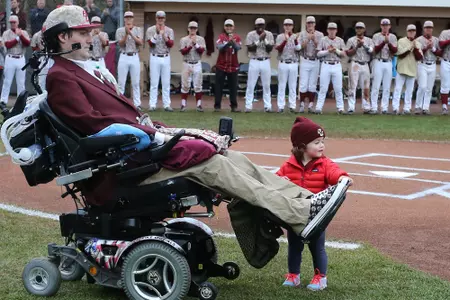
Photo by: John Quackenbos
Pete Frates, 1984-2019
December 11, 2019 | Baseball, #ForBoston Files
Thank you, Pete, for teaching us what it meant to be a hero.
I can still remember the first time John Frates said a line that stuck with me forever. I interviewed him on the ramp at the parking garage at Shea Field. It was cold because it was always cold over there, and we were among a great crowd tailgating up for a doubleheader.
I felt pretty lucky at all about stealing a couple of minutes of his time with the circus atmosphere around us, so I wanted to start the interview with a genuine ask of his son Pete's condition. Pete was well into his battle against ALS by then, and it felt like the family had some other wrinkle impacting his condition. I wanted to avoid being intrusive, so expressing a real concern for him stood out in my mind.
That's when John said something that never left me. Pete was doing all that he could, he explained, but he inevitably had days where he couldn't fight for himself. That's when others would step up and fight for him.
It rang truer than ever on Monday when Boston College announced that Pete Frates - baseball player, ALS patient, advocate, friend, father, husband, son, brother, and hero to so many more - finally succumbed to amyotrophic lateral sclerosis. He was 34.
"When you're a man of character and live a life of integrity, and the cause is just, people will follow," BC head baseball coach Mike Gambino said in a statement. "Pete represented everything we want in our student-athletes. He embodied character, toughness and class; living as a man for others to change the world."
It's hard to imagine a world without Pete Frates. ALS kept stealing physical attributes, but he kept persevering. He kept finding new levels of toughness because that's what he expected of himself. He never complained and never quit. That somehow made him invincible, like he could live forever as long as he kept fighting.
There would be the occasional hospitalization report, but Pete kept validating his fight. ALS is a fatal diagnosis, but as long as we saw Pete, at BC or on the news for a fleeting, brief moment, we all believed he would just keep going. He just kept beating ALS because he was still here, but he was never here for himself.
He was always winning because he lived - for his family, for his daughter, for other patients who would have been told they wouldn't see three years, let alone seven. He became a hero, inspiring others by facing down adversity with class and dignity and without any complaints.
"There is no one that embodied the spirit of Boston College more than Pete Frates," director of athletics Martin Jarmond said in a statement. "Pete's impact not only on our campus but nationally for his efforts in leading awareness for ALS will be remembered forever. He was a special person who led his life to the fullest, and I am just glad I had the honor of spending time with him. Our thoughts and prayers are with his family and friends."
Massachusetts feels like a small town, and the high school and local sports scene is something of a family reunion. So I always knew about Pete Frates as an athlete from his time spent at St. John's Prep. But I learned about the Frates family through the greater Boston College baseball brotherhood when I spent a good chunk of the 2016 season at Shea Field. Pete was well into his diagnosis at the time, but I didn't realize what exactly that meant to the Eagles, the program and the community at large.
Working with and around baseball enabled me to see players' reaction when I'd ask about the infamous "Pete on Facetime" at practice or before a game. It drove the aura and presence of the Team FrateTrain flag that hung in the dugout. It grabbed hold of my spirit and soul with a completely indescribable feeling. The magnetism provided me with renewed purpose and a genuine understanding of "men and women for others" as a selfless calling for life, and everyone I interviewed about ALS games or Pete Frates seemingly echoed that feeling. Every step of the entire 2016 postseason run included a reference to the ALS fight, and it really impacted me watching fans latch onto the Eagles during the Oxford Regional that year.
It eventually extended well beyond BC. There was Mike Martin from Florida State at Fenway for an ALS game, and NC State's fight with Chris Combs. Sam Kennedy from the Boston Red Sox and MLB Commissioner Rob Manfred lent unconditional support, and the Red Sox signed Pete to a contract. A sports writing legend like Steve Buckley always referred to Pete as the "greatest athlete in Boston history." Pete went into Cooperstown's Hall of Fame, and I watched Bill Gates, President George W. Bush, professional athletes and every person that I ever had a conversation with pour buckets of ice over their head to raise money and awareness for research.
I thought about that experience on Monday night. I wanted to remember those days before I went back further to when Pete played for BC, how he lived every Boston childhood dream by launching a home run at Fenway Park. I sought to relive the greatest high school baseball game ever played, in 2003, when St. John's Prep played Peabody in the MIAA Division I North semifinal, in which Frates and his teammates battled to a near-victory before falling to an exhausted, drained Peabody Tanner squad led by a first round draft pick on the mound.
It all flooded back to me in front of the keyboard as I reflected on what I knew about Pete Frates. His attitude as an athlete transferred perfectly to how he fought this disease. He was always willing to run out of his shoes to make a play, and he defied probability and percentages to fight ALS. It inspired all of us the same way it inspired teammates.
The disease ultimately got the last out, but it took extra innings. By the time it won, we understood all of its secrets. There are new treatments, and research breakthroughs brought on by the Ice Bucket Challenge are getting us closer to ultimate victory. It won the game, but Pete knew it would lose the series.
"Pete Frates possessed the characteristics we hold dear as a university-courage, integrity, selflessness, and a commitment to helping others," Boston College spokesman Jack Dunn said in a statement. "He accepted his illness and devoted the remaining years of his life to raising awareness of ALS and helping to raise money for a cure. He is a role model for all BC students and a beloved figure on our campus."
That's what Boston College baseball taught me about Pete Frates, and that what the Frates family taught me about fighting this disease. We all learned the meaning of brotherhood, family and selflessness. He now hands the torch to all of us, who stand ready to finish it in his name. Pete made history, and now it's our job to make sure ALS becomes history.
"This disease is going to end because of Pete Frates," Gambino said. "We are all the better for having known Pete and witnessed his courage in the face of true adversity. Like Pete, the entire Frates family will always be a part of our program and our hearts go out to them."
I felt pretty lucky at all about stealing a couple of minutes of his time with the circus atmosphere around us, so I wanted to start the interview with a genuine ask of his son Pete's condition. Pete was well into his battle against ALS by then, and it felt like the family had some other wrinkle impacting his condition. I wanted to avoid being intrusive, so expressing a real concern for him stood out in my mind.
That's when John said something that never left me. Pete was doing all that he could, he explained, but he inevitably had days where he couldn't fight for himself. That's when others would step up and fight for him.
It rang truer than ever on Monday when Boston College announced that Pete Frates - baseball player, ALS patient, advocate, friend, father, husband, son, brother, and hero to so many more - finally succumbed to amyotrophic lateral sclerosis. He was 34.
"When you're a man of character and live a life of integrity, and the cause is just, people will follow," BC head baseball coach Mike Gambino said in a statement. "Pete represented everything we want in our student-athletes. He embodied character, toughness and class; living as a man for others to change the world."
It's hard to imagine a world without Pete Frates. ALS kept stealing physical attributes, but he kept persevering. He kept finding new levels of toughness because that's what he expected of himself. He never complained and never quit. That somehow made him invincible, like he could live forever as long as he kept fighting.
There would be the occasional hospitalization report, but Pete kept validating his fight. ALS is a fatal diagnosis, but as long as we saw Pete, at BC or on the news for a fleeting, brief moment, we all believed he would just keep going. He just kept beating ALS because he was still here, but he was never here for himself.
He was always winning because he lived - for his family, for his daughter, for other patients who would have been told they wouldn't see three years, let alone seven. He became a hero, inspiring others by facing down adversity with class and dignity and without any complaints.
"There is no one that embodied the spirit of Boston College more than Pete Frates," director of athletics Martin Jarmond said in a statement. "Pete's impact not only on our campus but nationally for his efforts in leading awareness for ALS will be remembered forever. He was a special person who led his life to the fullest, and I am just glad I had the honor of spending time with him. Our thoughts and prayers are with his family and friends."
Massachusetts feels like a small town, and the high school and local sports scene is something of a family reunion. So I always knew about Pete Frates as an athlete from his time spent at St. John's Prep. But I learned about the Frates family through the greater Boston College baseball brotherhood when I spent a good chunk of the 2016 season at Shea Field. Pete was well into his diagnosis at the time, but I didn't realize what exactly that meant to the Eagles, the program and the community at large.
Working with and around baseball enabled me to see players' reaction when I'd ask about the infamous "Pete on Facetime" at practice or before a game. It drove the aura and presence of the Team FrateTrain flag that hung in the dugout. It grabbed hold of my spirit and soul with a completely indescribable feeling. The magnetism provided me with renewed purpose and a genuine understanding of "men and women for others" as a selfless calling for life, and everyone I interviewed about ALS games or Pete Frates seemingly echoed that feeling. Every step of the entire 2016 postseason run included a reference to the ALS fight, and it really impacted me watching fans latch onto the Eagles during the Oxford Regional that year.
It eventually extended well beyond BC. There was Mike Martin from Florida State at Fenway for an ALS game, and NC State's fight with Chris Combs. Sam Kennedy from the Boston Red Sox and MLB Commissioner Rob Manfred lent unconditional support, and the Red Sox signed Pete to a contract. A sports writing legend like Steve Buckley always referred to Pete as the "greatest athlete in Boston history." Pete went into Cooperstown's Hall of Fame, and I watched Bill Gates, President George W. Bush, professional athletes and every person that I ever had a conversation with pour buckets of ice over their head to raise money and awareness for research.
I thought about that experience on Monday night. I wanted to remember those days before I went back further to when Pete played for BC, how he lived every Boston childhood dream by launching a home run at Fenway Park. I sought to relive the greatest high school baseball game ever played, in 2003, when St. John's Prep played Peabody in the MIAA Division I North semifinal, in which Frates and his teammates battled to a near-victory before falling to an exhausted, drained Peabody Tanner squad led by a first round draft pick on the mound.
It all flooded back to me in front of the keyboard as I reflected on what I knew about Pete Frates. His attitude as an athlete transferred perfectly to how he fought this disease. He was always willing to run out of his shoes to make a play, and he defied probability and percentages to fight ALS. It inspired all of us the same way it inspired teammates.
The disease ultimately got the last out, but it took extra innings. By the time it won, we understood all of its secrets. There are new treatments, and research breakthroughs brought on by the Ice Bucket Challenge are getting us closer to ultimate victory. It won the game, but Pete knew it would lose the series.
"Pete Frates possessed the characteristics we hold dear as a university-courage, integrity, selflessness, and a commitment to helping others," Boston College spokesman Jack Dunn said in a statement. "He accepted his illness and devoted the remaining years of his life to raising awareness of ALS and helping to raise money for a cure. He is a role model for all BC students and a beloved figure on our campus."
That's what Boston College baseball taught me about Pete Frates, and that what the Frates family taught me about fighting this disease. We all learned the meaning of brotherhood, family and selflessness. He now hands the torch to all of us, who stand ready to finish it in his name. Pete made history, and now it's our job to make sure ALS becomes history.
"This disease is going to end because of Pete Frates," Gambino said. "We are all the better for having known Pete and witnessed his courage in the face of true adversity. Like Pete, the entire Frates family will always be a part of our program and our hearts go out to them."
Saturday, August 29
Saturday, August 29
Thursday, August 27
Wednesday, August 26