Boston College Athletics

Ever to Excel by Learning to Lead
December 13, 2016 | Boston College Athletics, #ForBoston Files
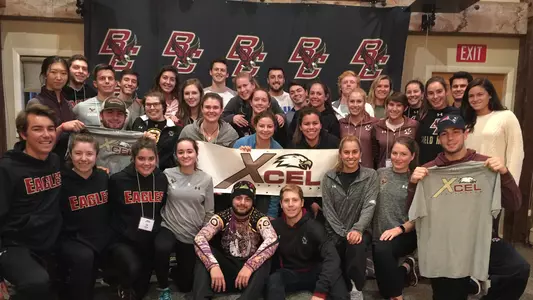
The Xcel Leadership Retreat brought athletes together from all walks of life.
It sounds like something out of an old MTV show: "What happens when you collect leaders from a school's college sports team and send them on a day-and-a-half retreat together? What would they talk about and what would they do? What happens when people stop being athletes from one sport and start being real?"
Boston College Athletics found the answer to those questions with its annual Xcel Leadership Training, a retreat that brings together current Eagle student-athletes with alumni and guest speakers to discuss how to be better leaders in their fields. It's one of those events building bridges over the silo walls of individual sports.
The summit brings together athletes from all walks of life and disciplines. Coaches nominate student-athletes, who attend the multi-day retreat to discuss leadership skills. They listen to guest speakers and take part in case studies and activities. It breaks down walls and blends athletics cultures into one, a place where challenges and opportunities are discussed.
"We really got to hear from each other and speakers, to listen to everyone's story," said Mary Kate O'Neil, a senior on the lacrosse team. "We all spoke about our experiences as leaders and we learned about what it means to be a role model. We got to talk to other student-athletes outside of sports and social settings. We learned what makes each team great in their own way and we got to listen to the challenges that everyone has. It was so much fun, in an atmosphere that's relaxed, well-timed and reflective."
The baseball team's senior Johnny Adams echoed that sentiment.
"It's unbelievable and unique in its own way," he said. "We learned a lot about leadership, about the qualities that make a leader. We also got exposure to the experiences of other teams, which gives everyone a different perspective to the issues that everyone might be facing."
More than just groups of current athletes, the summit ties together alumni and honored guests from all walks of life. This year, that included Sean Guthrie, a 2001 graduate from the football program, along with Tom Daley of the United States Special Forces and Tony Hatala of the United States Marine Corps Reserve.
"It's a combination of listening to us and others on a number of different areas," O'Neil said. "We got to really hear their stories, about their decision-making process, and then through case studies be able to apply them."
It's an event that draws on each year's previous experience. The rowing team's Makenzy Brown, a senior, attended last year's session as a representative of her team. She explained how the experience helped her reflect personally, allowing her to then grow as an athlete. So when the opportunity arose to go to the retreat for a second year, this time as a leader, she jumped at the chance.
"I really liked the event last year," she said. "I went into it with an open mind and found that it really helped me personally. So this was really a cool opportunity to go back and do more personal reflection."
Each student-athlete conveyed the same message about the program, how it will help them become leaders on their own teams based on what they've learned about others.
"You really get to see the crossover between the teams," Brown said. "Every team has the same dynamics during a year. It's the same experiences about learning how to trust teammates or avoid communication breakdowns, and a lot of teams have different approaches. So it creates a space to really learn about what everyone does, which allows us to apply to our own teams. That's one of my favorite things."
O'Neil affirmed the point, describing how each team learns how to deal with similar opportunities for growth. College is a unique place to begin with, where young players who may be away from home for the first time are blending with people who are in their fourth year of competition.
"In freshman, sophomore and junior year, it was good enough to just show up and compete," she said. "As a senior, I know that I'm really being looked at to be that leader, to connect with all of my teammates, and be mindful and supportive of them. The retreat really helped me understand the importance of that relationship, which I know I can bring back to my team."
Along with those ideas, the student-athletes heard from people like Guthrie, who touched a nerve with his talk about transitioning to life after Chestnut Hill.
"It was really great to listen to the alumni panel," Brown said. "A lot of us were hearing about how they transitioned into the 'real world.' We're all getting closer to that point, so listening to them can help all of us apply lessons for when we join them in that world."
Perhaps most importantly, though, the training helps shatter the walls between teams. Teams compete in their own unique society, which often gathers its own culture, traditions and training. A baseball player is different than a basketball player and a golfer is different from a lacrosse player. Each sport has its own deep roots at every level so it can be easy to miss similarities.
"It's really cool to just tie all of the sports together like that," Adams said. "All of us are able to come back to one or two things that everyone is going through in their own way. At the same time, everyone handles it differently, so it gives us all a chance to really learn a lot and get different perspectives on how to handle the same situation. We're all definitely different but this allowed us to become similar too."
"We really hoped to improve the program," Brown said. "I feel like we did a good job. The feedback that we've been receiving has all been positive. The messages can be powerful, so hopefully we can inspire more people to come back (to future retreats). There's a lot of different things for different people, so it can be a good experience for everyone."
Boston College Athletics found the answer to those questions with its annual Xcel Leadership Training, a retreat that brings together current Eagle student-athletes with alumni and guest speakers to discuss how to be better leaders in their fields. It's one of those events building bridges over the silo walls of individual sports.
The summit brings together athletes from all walks of life and disciplines. Coaches nominate student-athletes, who attend the multi-day retreat to discuss leadership skills. They listen to guest speakers and take part in case studies and activities. It breaks down walls and blends athletics cultures into one, a place where challenges and opportunities are discussed.
"We really got to hear from each other and speakers, to listen to everyone's story," said Mary Kate O'Neil, a senior on the lacrosse team. "We all spoke about our experiences as leaders and we learned about what it means to be a role model. We got to talk to other student-athletes outside of sports and social settings. We learned what makes each team great in their own way and we got to listen to the challenges that everyone has. It was so much fun, in an atmosphere that's relaxed, well-timed and reflective."
The baseball team's senior Johnny Adams echoed that sentiment.
"It's unbelievable and unique in its own way," he said. "We learned a lot about leadership, about the qualities that make a leader. We also got exposure to the experiences of other teams, which gives everyone a different perspective to the issues that everyone might be facing."
More than just groups of current athletes, the summit ties together alumni and honored guests from all walks of life. This year, that included Sean Guthrie, a 2001 graduate from the football program, along with Tom Daley of the United States Special Forces and Tony Hatala of the United States Marine Corps Reserve.
"It's a combination of listening to us and others on a number of different areas," O'Neil said. "We got to really hear their stories, about their decision-making process, and then through case studies be able to apply them."
It's an event that draws on each year's previous experience. The rowing team's Makenzy Brown, a senior, attended last year's session as a representative of her team. She explained how the experience helped her reflect personally, allowing her to then grow as an athlete. So when the opportunity arose to go to the retreat for a second year, this time as a leader, she jumped at the chance.
"I really liked the event last year," she said. "I went into it with an open mind and found that it really helped me personally. So this was really a cool opportunity to go back and do more personal reflection."
Each student-athlete conveyed the same message about the program, how it will help them become leaders on their own teams based on what they've learned about others.
"You really get to see the crossover between the teams," Brown said. "Every team has the same dynamics during a year. It's the same experiences about learning how to trust teammates or avoid communication breakdowns, and a lot of teams have different approaches. So it creates a space to really learn about what everyone does, which allows us to apply to our own teams. That's one of my favorite things."
O'Neil affirmed the point, describing how each team learns how to deal with similar opportunities for growth. College is a unique place to begin with, where young players who may be away from home for the first time are blending with people who are in their fourth year of competition.
"In freshman, sophomore and junior year, it was good enough to just show up and compete," she said. "As a senior, I know that I'm really being looked at to be that leader, to connect with all of my teammates, and be mindful and supportive of them. The retreat really helped me understand the importance of that relationship, which I know I can bring back to my team."
Along with those ideas, the student-athletes heard from people like Guthrie, who touched a nerve with his talk about transitioning to life after Chestnut Hill.
"It was really great to listen to the alumni panel," Brown said. "A lot of us were hearing about how they transitioned into the 'real world.' We're all getting closer to that point, so listening to them can help all of us apply lessons for when we join them in that world."
Perhaps most importantly, though, the training helps shatter the walls between teams. Teams compete in their own unique society, which often gathers its own culture, traditions and training. A baseball player is different than a basketball player and a golfer is different from a lacrosse player. Each sport has its own deep roots at every level so it can be easy to miss similarities.
"It's really cool to just tie all of the sports together like that," Adams said. "All of us are able to come back to one or two things that everyone is going through in their own way. At the same time, everyone handles it differently, so it gives us all a chance to really learn a lot and get different perspectives on how to handle the same situation. We're all definitely different but this allowed us to become similar too."
"We really hoped to improve the program," Brown said. "I feel like we did a good job. The feedback that we've been receiving has all been positive. The messages can be powerful, so hopefully we can inspire more people to come back (to future retreats). There's a lot of different things for different people, so it can be a good experience for everyone."
#23 Baseball Defeats Virginia Tech (April 11,2026
Saturday, April 11
Football: Zeke Moore Media Availability (April 10, 2026)
Friday, April 10
Football: Bill O'Brien Media Availability (April 10, 2026)
Friday, April 10
Football: Favor Bate Media Availability (April 10, 2026)
Friday, April 10