Boston College Athletics
The Banner And The Meaning
November 27, 2016 | Men's Hockey, #ForBoston Files
What Mike Mottau's name in the rafters means to history.
Retired jerseys often represent so many different characteristics about an era. It's a reflection of the player's everlasting impact, but the accompanying nostalgia makes everyone - from the coaches to the honored player to the fans - reflect about the time that was. The discussion always starts with the player but inevitably steers towards the exemplifying standards and memories from that person's years.
When Mike Mottau arrived at Boston College in the fall of 1996, he came to a program that wasn't a national powerhouse. There was the history and tradition, but head coach Jerry York hadn't won a postseason game in his first two years and the sub-.500 records rode a tough, multiple-year streak.
The Eagles hadn't made the national tournament in five years and hadn't made the Frozen Four in six years. The only national championship was from 1949, the second ever NCAA Tournament when only four teams qualified. It contrasted with the fortunes down the Green Line where Boston University had won the 1995 national championship.
Four years later, though, Boston College was back.
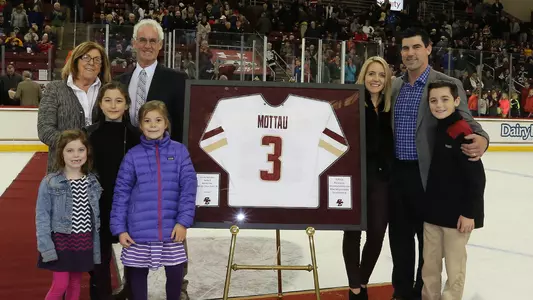
On Sunday afternoon, Mike Mottau stood at center ice at Conte Forum, looked up and watched as a black covering fell away to reveal his name hanging in the rafters. Alongside the legends of Boston College's past, he now stood, seeing his name forever etched into the annals of history, the example and statement by which the Boston College renaissance would begin.
"I got a little bit more emotional than I kind of expected," Mottau said. "It's a real honor to see (the banner) next to some real BC legends, and to be part of that is great. I was a part of some great teams for four years, made some lifelong friends, and I'm just fortunate to have the opportunity to have been here at BC."
Mottau's four-year odyssey at BC helped engineer an immediate return to power for one of college hockey's elite names. The Eagles won 99 games and two Hockey East championships. BC went to three straight NCAA Tournaments, three straight Frozen Fours and two national championship game appearances.
Along the way, Mottau rewrote pages in the Boston College history book. As a defenseman, he tallied 130 assists, breaking a record by the legendary David Emma. He posted three straight 40-point seasons, exemplifying consistency. In 1999 and 2000, he won the Walter Brown Award, given to the best American born collegiate hockey player in New England. Prior to Harvard's Jimmy Vesey winning the award in '15 and '16, Mottau was the most recent back-to-back winner.
In 2000, he became just the second Hobey Baker Award winner in program history, joining Emma in the exclusive club, besting two teammates - forwards Brian Gionta and Jeff Farkas - for the honor.
"It was the day-to-day grind that we all signed up to do," Mottau said, "and we did it together. We worked together, we won together, and we lost together. Those bonds are forever because of that."
Perhaps most importantly, it set the stage for championships and trophy seasons. In 2001, a year after Mottau graduated, Boston College won its first national championship in 52 years, adding three more in five years at the end of the decade. Once one of two Hobey Baker Award winners, there are now three, as Johnny Gaudreau took the honor in 2012.
"To have had some small part to restore the tradition that is Boston College makes us a proud group," Mottau said. "We're proud alumni, and we're always looking to get together. We're a really tight-knit group, and that's a testament to Jerry York recruiting great character people. For generations of great hockey players to come together year after year, it creates a great community to be a part of."
Mike Mottau graduated from Boston College, matriculated into the AHL and eventually found himself enjoying a career playing at the highest professional levels. After first tasting the professional levels of hockey as a member of Team USA at the 1999 and 2000 World Championships, he graduated from BC and began his professional career with the team that drafted him. Eventually settling in with the New Jersey Devils for his most productive years, he retired following stints with the New York Islanders, Boston Bruins and Florida Panthers. Including time spent with the New York Rangers, who drafted him, and the Calgary Flames, he played 321 games for five franchises, tallying 58 career points.
He remained an Eagle, a local kid who came to play, like so many, for the local team. In the mid-1990s, the parochial nature of the Boston area played out on rinks during the college season. Rivalries baked their way into the roots of Avon, Arlington, Belmont, Chestnut Hill, Brighton, Melrose and Stoneham. Part of the the local players who restored the pride back to Conte Forum, it's always something that's remained close to Mike Mottau's heart.
"It gave me a chance to go home and get home cooked meal and get my laundry done," he joked. "Ultimately, though, it was great to play close enough to home to have my family, my parents and my friends come and watch me. Playing in the Beanpot was extremely special, plus I received a great education from a great school. It was the best of everything, with the proximity being close to home, which made it that much more amazing."
That's one way of putting it. When Mike Mottau arrived at Boston College, the program was a dormant giant, waiting to come out of its darkness and into its brightest hour. When he left, the program was ready to become the greatest in the nation. As his name hangs among the other legends of the Eagles hockey program - the Snooks Kelleys, the Len Ceglarskis, the Billy Daleys, the Red Martins, the Ray Chaissons and even the David Emmas - it stands emblematic of exactly that time when BC came back. Some might call it amazing, but from Sunday moving forward, it can be called something else - immortal.
When Mike Mottau arrived at Boston College in the fall of 1996, he came to a program that wasn't a national powerhouse. There was the history and tradition, but head coach Jerry York hadn't won a postseason game in his first two years and the sub-.500 records rode a tough, multiple-year streak.
The Eagles hadn't made the national tournament in five years and hadn't made the Frozen Four in six years. The only national championship was from 1949, the second ever NCAA Tournament when only four teams qualified. It contrasted with the fortunes down the Green Line where Boston University had won the 1995 national championship.
Four years later, though, Boston College was back.
On Sunday afternoon, Mike Mottau stood at center ice at Conte Forum, looked up and watched as a black covering fell away to reveal his name hanging in the rafters. Alongside the legends of Boston College's past, he now stood, seeing his name forever etched into the annals of history, the example and statement by which the Boston College renaissance would begin.
"I got a little bit more emotional than I kind of expected," Mottau said. "It's a real honor to see (the banner) next to some real BC legends, and to be part of that is great. I was a part of some great teams for four years, made some lifelong friends, and I'm just fortunate to have the opportunity to have been here at BC."
Mottau's four-year odyssey at BC helped engineer an immediate return to power for one of college hockey's elite names. The Eagles won 99 games and two Hockey East championships. BC went to three straight NCAA Tournaments, three straight Frozen Fours and two national championship game appearances.
Along the way, Mottau rewrote pages in the Boston College history book. As a defenseman, he tallied 130 assists, breaking a record by the legendary David Emma. He posted three straight 40-point seasons, exemplifying consistency. In 1999 and 2000, he won the Walter Brown Award, given to the best American born collegiate hockey player in New England. Prior to Harvard's Jimmy Vesey winning the award in '15 and '16, Mottau was the most recent back-to-back winner.
In 2000, he became just the second Hobey Baker Award winner in program history, joining Emma in the exclusive club, besting two teammates - forwards Brian Gionta and Jeff Farkas - for the honor.
"It was the day-to-day grind that we all signed up to do," Mottau said, "and we did it together. We worked together, we won together, and we lost together. Those bonds are forever because of that."
Perhaps most importantly, it set the stage for championships and trophy seasons. In 2001, a year after Mottau graduated, Boston College won its first national championship in 52 years, adding three more in five years at the end of the decade. Once one of two Hobey Baker Award winners, there are now three, as Johnny Gaudreau took the honor in 2012.
"To have had some small part to restore the tradition that is Boston College makes us a proud group," Mottau said. "We're proud alumni, and we're always looking to get together. We're a really tight-knit group, and that's a testament to Jerry York recruiting great character people. For generations of great hockey players to come together year after year, it creates a great community to be a part of."
Mike Mottau graduated from Boston College, matriculated into the AHL and eventually found himself enjoying a career playing at the highest professional levels. After first tasting the professional levels of hockey as a member of Team USA at the 1999 and 2000 World Championships, he graduated from BC and began his professional career with the team that drafted him. Eventually settling in with the New Jersey Devils for his most productive years, he retired following stints with the New York Islanders, Boston Bruins and Florida Panthers. Including time spent with the New York Rangers, who drafted him, and the Calgary Flames, he played 321 games for five franchises, tallying 58 career points.
He remained an Eagle, a local kid who came to play, like so many, for the local team. In the mid-1990s, the parochial nature of the Boston area played out on rinks during the college season. Rivalries baked their way into the roots of Avon, Arlington, Belmont, Chestnut Hill, Brighton, Melrose and Stoneham. Part of the the local players who restored the pride back to Conte Forum, it's always something that's remained close to Mike Mottau's heart.
"It gave me a chance to go home and get home cooked meal and get my laundry done," he joked. "Ultimately, though, it was great to play close enough to home to have my family, my parents and my friends come and watch me. Playing in the Beanpot was extremely special, plus I received a great education from a great school. It was the best of everything, with the proximity being close to home, which made it that much more amazing."
That's one way of putting it. When Mike Mottau arrived at Boston College, the program was a dormant giant, waiting to come out of its darkness and into its brightest hour. When he left, the program was ready to become the greatest in the nation. As his name hangs among the other legends of the Eagles hockey program - the Snooks Kelleys, the Len Ceglarskis, the Billy Daleys, the Red Martins, the Ray Chaissons and even the David Emmas - it stands emblematic of exactly that time when BC came back. Some might call it amazing, but from Sunday moving forward, it can be called something else - immortal.
#22 Baseball Defeats NJIT (May 10, 2026)
Monday, May 11
Lacrosse: NCAA Tournament First Round Postgame Press Conference (May 8, 2026)
Saturday, May 09
Women's Basketball: Coach Pop Joins ACC Network Basketball Podcast
Tuesday, May 05
#20 Baseball Defeats Clemson (May 1, 2026)
Saturday, May 02