Boston College Athletics
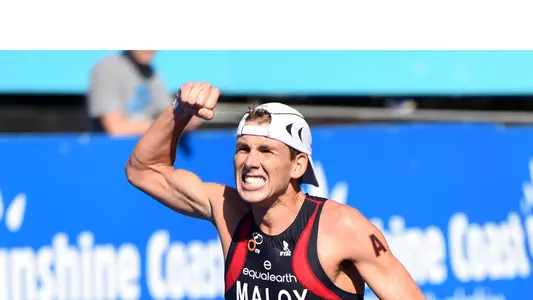
Photo by: Delly Carr
Maloy, BC Alum, Victorious in Australia
December 08, 2015 | Swimming
Fresh off of his victory in the Noosa Triathlon in Queensland, Australia, in November with a time of 1:47:04, former BC Eagles Swim and Dive team captain Joe Maloy '08 sat down with BCEagles.com to talk about his recent victory as well as his career as a triathlete.
Q: You were the first American to win the Noosa Triathlon down in Australia. Were there any nerves racing so far away from home? Did being there put you out of your comfort zone/mess around with your routine when it came to racing, or was it just business as usual?
Joe Maloy (JM): I think nerves are involved anytime one takes a risk and opens him or herself to the possibility of failure. Overcoming that feeling is part of what draws me to competition. The key is using that energy to help you accomplish the task at hand — to not let it distract you. If whatever you're doing doesn't make you nervous, you probably aren't challenging yourself enough. [Also] The distance from home didn't change anything for me. I have confidence in myself and my preparation, and that's something that doesn't change with location.
Q: You were a four year swimmer while at BC and team captain during your senior year AND you went on to coach the Eagles for a few years after that. What was the inspiration for you to begin to pursue triathlons, of all things?
JM: The reason I pursued triathlons was because of BC's Head Swimming Coach, Tom Groden. While serving as Tom's assistant coach from 2008-2010, I was inspired by the student-athletes. I saw how hard they worked both in and out of the pool, and it gave me a deeper appreciation for sport. Instead of being a distraction from life, I started to see athletic competition as a medium to achieve personal growth. Guiding them to achieve their goals reignited a fire in me to go and do the same. Between taking classes and coaching, I swam, biked, and ran in my free time. I noticed the hard efforts helped me focus. I'd have better days in the office and on deck after I did my triathlon training.
Q: Going off of that, did anything besides your time on the swim team at BC stick with you going forward in pursuing your career as a triathlete?
JM: It's funny you should mention that. It turns out the training I did to help my swimming at BC served as a great foundation for my triathlon career. Coach Groden runs a unique program where the athletes are empowered to choose training that fits their strengths. Not many high-level coaches allow for that kind of flexibility, and I was successful both at Boston College and beyond because of that structure.
I did spinning classes and went for runs to supplement my pool training. I even threw in some Joe-ga. ("Joe-ga" is what I call my attempt at yoga). At the time I did this stuff because I enjoyed the cross-training. Looking back, it was a great foundation for my triathlon career.
[In terms of outside of athletics,] Cathy Utzschneider had a class in the Woods College of Advancing Studies called "High Performers." Studying the time management, goal setting, and habits of high achievers changed my understanding of excellence. I learned the actionable steps I could take to realize my own goals. [Additionally,] Fr. Farrell's senior capstone class, "Five Heroic Americans," is another one that has guided my athletic pursuits. My classmates and I discussed weekly readings in the context of our relationships, work, civic responsibility, and spirituality. Discussing these hallmarks of character taught me to critically evaluate my development in and contributions to these areas [and] encouraged me to live BC's "Ever to Excel" motto.
The self-awareness I gained through those discussions […] will continue to guide my choices as I work towards the 2016 Olympics.
Q: Winning a triathlon is a pretty significant accomplishment. What do you do next? Do you keep racing? Take a break? Any reason for your decision, whatever that may be?
JM: For 49 weeks/year, I need to be focused on my training. Noosa marked the end of my 49th week, so afterwards I had the opportunity to enjoy myself! I stayed in Australia for a few days to surf, stand up paddle, and explore the area, but then I was very excited to hop on a plane and visit my family and friends back on the east coast. In the couple of weeks that followed I visited friends in New York City and Boston, and then spent Thanksgiving week with my family in Florida.
Having focus is very important. In order to keep that focus, it's important to let the mind and body relax, recover, and get ready to do it again at a higher level. Now, I'm back at my training base in San Diego, CA, prepping for the final Olympic qualification event next May in Yokohama, Japan. After that race, I'll know whether or not I've qualified to race for the US Triathlon Team in Rio next August.
Additional information about Joe Maloy and his future endeavors can be found on his website, joetriathlon.com
Q: You were the first American to win the Noosa Triathlon down in Australia. Were there any nerves racing so far away from home? Did being there put you out of your comfort zone/mess around with your routine when it came to racing, or was it just business as usual?
Joe Maloy (JM): I think nerves are involved anytime one takes a risk and opens him or herself to the possibility of failure. Overcoming that feeling is part of what draws me to competition. The key is using that energy to help you accomplish the task at hand — to not let it distract you. If whatever you're doing doesn't make you nervous, you probably aren't challenging yourself enough. [Also] The distance from home didn't change anything for me. I have confidence in myself and my preparation, and that's something that doesn't change with location.
Q: You were a four year swimmer while at BC and team captain during your senior year AND you went on to coach the Eagles for a few years after that. What was the inspiration for you to begin to pursue triathlons, of all things?
JM: The reason I pursued triathlons was because of BC's Head Swimming Coach, Tom Groden. While serving as Tom's assistant coach from 2008-2010, I was inspired by the student-athletes. I saw how hard they worked both in and out of the pool, and it gave me a deeper appreciation for sport. Instead of being a distraction from life, I started to see athletic competition as a medium to achieve personal growth. Guiding them to achieve their goals reignited a fire in me to go and do the same. Between taking classes and coaching, I swam, biked, and ran in my free time. I noticed the hard efforts helped me focus. I'd have better days in the office and on deck after I did my triathlon training.
Q: Going off of that, did anything besides your time on the swim team at BC stick with you going forward in pursuing your career as a triathlete?
JM: It's funny you should mention that. It turns out the training I did to help my swimming at BC served as a great foundation for my triathlon career. Coach Groden runs a unique program where the athletes are empowered to choose training that fits their strengths. Not many high-level coaches allow for that kind of flexibility, and I was successful both at Boston College and beyond because of that structure.
I did spinning classes and went for runs to supplement my pool training. I even threw in some Joe-ga. ("Joe-ga" is what I call my attempt at yoga). At the time I did this stuff because I enjoyed the cross-training. Looking back, it was a great foundation for my triathlon career.
[In terms of outside of athletics,] Cathy Utzschneider had a class in the Woods College of Advancing Studies called "High Performers." Studying the time management, goal setting, and habits of high achievers changed my understanding of excellence. I learned the actionable steps I could take to realize my own goals. [Additionally,] Fr. Farrell's senior capstone class, "Five Heroic Americans," is another one that has guided my athletic pursuits. My classmates and I discussed weekly readings in the context of our relationships, work, civic responsibility, and spirituality. Discussing these hallmarks of character taught me to critically evaluate my development in and contributions to these areas [and] encouraged me to live BC's "Ever to Excel" motto.
The self-awareness I gained through those discussions […] will continue to guide my choices as I work towards the 2016 Olympics.
Q: Winning a triathlon is a pretty significant accomplishment. What do you do next? Do you keep racing? Take a break? Any reason for your decision, whatever that may be?
JM: For 49 weeks/year, I need to be focused on my training. Noosa marked the end of my 49th week, so afterwards I had the opportunity to enjoy myself! I stayed in Australia for a few days to surf, stand up paddle, and explore the area, but then I was very excited to hop on a plane and visit my family and friends back on the east coast. In the couple of weeks that followed I visited friends in New York City and Boston, and then spent Thanksgiving week with my family in Florida.
Having focus is very important. In order to keep that focus, it's important to let the mind and body relax, recover, and get ready to do it again at a higher level. Now, I'm back at my training base in San Diego, CA, prepping for the final Olympic qualification event next May in Yokohama, Japan. After that race, I'll know whether or not I've qualified to race for the US Triathlon Team in Rio next August.
Additional information about Joe Maloy and his future endeavors can be found on his website, joetriathlon.com

No. 20 Baseball defeats UMass Lowell (April 28, 2026)
Wednesday, April 29
From the Desk of Blake James | Episode 8
Friday, April 24
Baseball: 2026 ALS Game vs Virginia Tech Recap
Tuesday, April 21
No. 24 Baseball Defeats Duke (April 18, 2026) - Game 2
Sunday, April 19